ACCA – Advanced Financial Management (AFM)
This course provides in-depth knowledge and skills in advanced financial management. Ideal for finance professionals looking to enhance their strategic decision-making capabilities.
Program rating
1,937+
Learners enrolled
70 hrs
Total duration
English,Hindi
Language
This program includes
Program overview
About this program
This Finance & Taxation program blends live, mentor-led sessions with hands-on projects and real-world case studies, so you build genuinely job-ready skills — not just theory. You'll learn from working industry experts, apply what you learn on practical assignments, and finish with a portfolio, a recognized certificate, and dedicated placement support to help you land the right role.
This course provides in-depth knowledge and skills in advanced financial management. Ideal for finance professionals looking to enhance their strategic decision-making capabilities.
The ACCA Advanced Financial Management (AFM) course is designed to equip finance professionals with the necessary tools for effective financial management in an organization. The course covers topics such as financial strategy, risk management, and advanced investment appraisal techniques. Through a combination of theoretical concepts and practical applications, participants will learn how to critically evaluate financial performance and make informed decisions.
Why learners love this program
- Strategic financial management and value creation — developing financial strategy, corporate valuation, and long-term decision frameworks to drive shareholder value.
- Advanced investment appraisal and financing techniques — applying capital budgeting, real options, project appraisal, and optimal financing structures for complex investments.
- Financial risk management and treasury operations — identifying, measuring and managing market, credit and liquidity risk using hedging, derivatives and treasury best practices.
35
Lectures
70
Hours
All level
Level
Globally trusted accreditations
Recognitions that power your profile
Trusted by leading accreditation bodies — so your certificate is respected by employers worldwide.










Learning outcomes
What you'll be able to do
Curriculum
Structured modules that build real skills
17 modules · designed for progressive, hands-on learning.
Key Concepts and Scope
Explain the principal concepts and scope of advanced financial management and how they apply to organisational decision-making.
Role of the Financial Manager
Describe the responsibilities of the financial manager and how advanced techniques support strategic objectives.
Strategic Frameworks
Introduce strategic frameworks used to align financial strategy with overall business strategy.
Value Creation and Shareholder Wealth
Explain how financial strategy drives value creation and the measures used to assess shareholder wealth.
Policy Formulation
Describe the process of formulating financial policies including dividend, investment and financing policies.
Performance Targets and KPIs
Define key performance indicators and targets that support implementation and monitoring of the financial strategy.
Time Value of Money and Cash Flows
Apply time value of money concepts and construct cash flow profiles for investment projects.
Net Present Value and Internal Rate of Return
Calculate and interpret NPV and IRR to support investment decision-making.
Project Selection and Sensitivity Analysis
Use sensitivity and scenario analysis to assess project robustness and support selection among alternatives.
Real Options and Risk-adjusted Discount Rates
Explain real options valuation and the use of risk-adjusted discount rates in uncertain investment appraisal.
Portfolio-level Appraisal and Capital Rationing
Evaluate investment decisions at the portfolio level and apply capital rationing techniques for optimal selection.
Types of Financial Risk
Identify and classify financial risks including market, credit, liquidity and operational risks.
Risk Assessment Frameworks
Apply frameworks to assess and prioritise risks relevant to financial decision-making.
Hedging and Derivatives
Describe hedging strategies using derivatives and evaluate their effectiveness in risk mitigation.
Value at Risk and Scenario Analysis
Apply VaR and scenario analysis techniques to quantify potential losses and stress-test portfolios.
Cost of Capital and Capital Structure Theory
Explain cost of capital components and capital structure theories that influence financing choices.
Taxation and Agency Effects
Assess the impact of taxation and agency costs on optimal capital structure decisions.
Equity and Debt Instruments
Compare features, advantages and implications of different equity and debt financing instruments.
Hybrid Financing and Leasing
Evaluate hybrid financing options and leasing as alternatives to traditional debt and equity.
Financial Ratios and Economic Profit
Use advanced financial ratios and economic profit measures to evaluate organisational performance.
Balanced Scorecard and Non-financial Metrics
Integrate non-financial metrics with financial measures using the balanced scorecard approach.
Trend and Variance Analysis
Perform trend and variance analysis to interpret performance movements and drivers.
Benchmarking and Peer Comparison
Apply benchmarking techniques for peer comparison and identify areas for performance improvement.
Budgeting Approaches and Process
Explain different budgeting approaches and design a budgeting process aligned with strategic goals.
Forecasting Drivers and Assumptions
Identify key drivers and assumptions in forecasting and assess their influence on financial plans.
Rolling Forecasts and Scenario Planning
Implement rolling forecasts and scenario planning to maintain agility in financial planning.
Forecasting Models and Software Use
Apply quantitative forecasting models and appropriate software tools to generate reliable projections.
Professional Ethics and Governance
Explain the role of professional ethics and corporate governance in financial decision-making.
Ethical Dilemmas and Decision-making
Analyse common ethical dilemmas faced by finance professionals and apply frameworks for resolution.
Valuation Methods for M&A
Apply valuation methods used in M&A including DCF, multiples and comparable transactions.
Due Diligence and Deal Valuation Adjustments
Conduct financial due diligence and make valuation adjustments to reflect deal-specific risks.
Financing and Deal Structuring
Design financing structures and consider tax and regulatory implications for M&A deals.
Post-merger Integration and Synergy Realisation
Plan integration activities and evaluate how synergies can be realised and measured post-transaction.
Summary of Key Takeaways
Summarise the course's core concepts and how they integrate to support advanced financial management.
Emerging Trends and Continuing Professional Development
Identify emerging trends in financial management and outline steps for continuing professional development.
Your credential
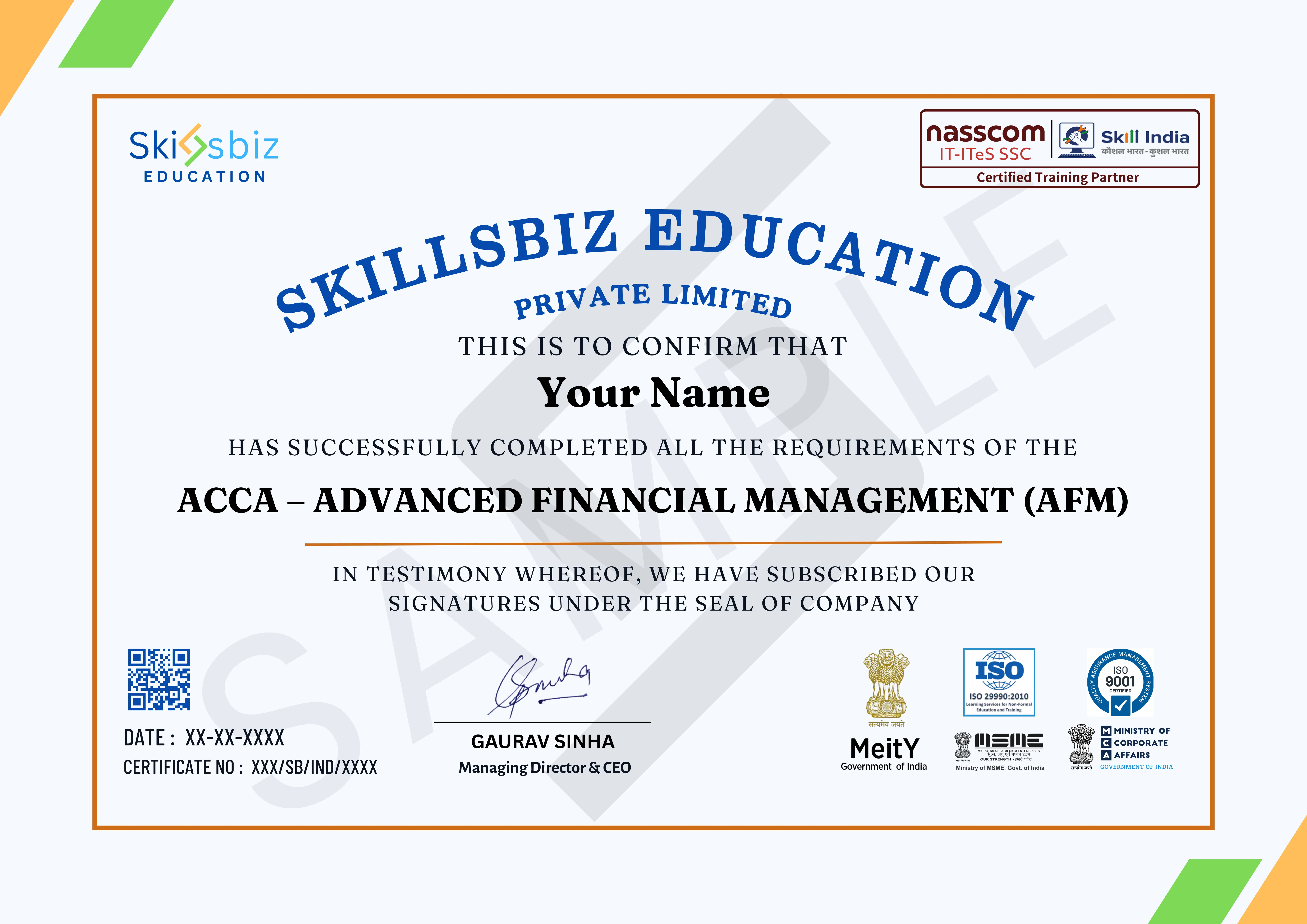
The certificate you'll earn
Earn an industry-recognized certificate on successful completion of this program.
Personalised guidance
Book a free discovery call with our specialists
Get tailored advice on learning paths, certification journeys, and industry opportunities before you enroll.
- Understand the skill gaps holding you back and the modules that close them.
- Get a cohort recommendation based on availability and your weekly bandwidth.
- Discover certification add-ons that strengthen your CV.
Reserve your slot
Share your details and we'll connect within 24 hours.
Reviews
What our learners say
Advanced Financial Management improved my understanding of valuation and international finance. Regular case practice helped me structure long answers effectively.
Learning advanced financing strategies helped me see corporate decision-making from a strategic angle. AFM preparation felt structured and professional.
ACCA Advanced Financial Management helped me understand strategic financial planning clearly. Working on mergers and acquisitions cases improved my analytical thinking.
AFM preparation clarified international finance and foreign exchange risk management concepts. Working through integrated scenarios strengthened my judgement skills.
AFM preparation strengthened my understanding of risk management and mergers. Analysing advanced case studies helped me develop a professional approach to financial decision-making.
ACCA Advanced Financial Management helped me understand complex investment and financing decisions at a strategic level. Working on international business finance scenarios improved my analytical depth significantly.
FAQ
Your questions, answered
Everything you need to know before you enroll. Still unsure? Our advisors are one call away.
Honored for excellence
Awards & recognitions
Our pedagogy, learner outcomes, and mentor network have been acknowledged by industry councils and global forums.





Media spotlight
Featured in leading publications










Ready to start ACCA – Advanced Financial Management (AF...?
Enroll today or book a free counselling call to get a personalized learning path.