ACCA– Financial Accounting (FA)
Master the fundamentals of Financial Accounting and get prepared for ACCA examinations.
Program rating
1,963+
Learners enrolled
70 hrs
Total duration
English,Hindi
Language
This program includes

Program overview
About this program
This Finance & Taxation program blends live, mentor-led sessions with hands-on projects and real-world case studies, so you build genuinely job-ready skills — not just theory. You'll learn from working industry experts, apply what you learn on practical assignments, and finish with a portfolio, a recognized certificate, and dedicated placement support to help you land the right role.
Master the fundamentals of Financial Accounting and get prepared for ACCA examinations.
This comprehensive course covers key concepts in Financial Accounting, providing the knowledge needed to prepare financial statements, understand accounting standards, and develop analytical skills for effective financial analysis.
Why learners love this program
- IFRS-aligned fundamentals: core accounting principles, double-entry bookkeeping, and the conceptual framework
- Financial statement preparation: recognition, measurement, and presentation of assets, liabilities, income, and expenses for single entities
- Exam-focused practice and analytical skills: past-paper questions, examiner techniques, and interpretation of financial statements for decision-making
35
Lectures
70
Hours
All level
Level
Globally trusted accreditations
Recognitions that power your profile
Trusted by leading accreditation bodies — so your certificate is respected by employers worldwide.










Learning outcomes
What you'll be able to do
Curriculum
Structured modules that build real skills
19 modules · designed for progressive, hands-on learning.
Purpose and Users of Financial Accounting
Explain who uses financial statements and why, and identify the main purposes of financial accounting.
Basic Accounting Concepts and Conventions
Describe fundamental accounting concepts such as accruals, going concern, and materiality, and explain their role in financial reporting.
Accounting Equation and Double-Entry System
Demonstrate the accounting equation and apply double-entry bookkeeping for simple transactions.
The Accounting Cycle: From Transactions to Reports
Outline each step of the accounting cycle and show how transactions flow into financial statements.
Source Documents and Recording Rules
Identify common source documents and apply rules for recording business transactions accurately.
The Journal: Recording and Formats
Prepare journal entries in proper format and explain the classification of debits and credits.
Posting to Ledgers and Subsidiary Books
Post journal entries to ledger accounts and maintain subsidiary books to track account balances.
Preparing a Trial Balance
Prepare a trial balance to verify ledger balances and detect arithmetical errors.
Error Detection and Correction
Identify common bookkeeping errors and apply correction techniques to restore accurate records.
Sales, Purchases and Returns Accounting
Account for sales, purchases, returns and allowances, and distinguish between cash and credit transactions.
Compound and Adjusting Entries for Complex Transactions
Prepare compound journal entries and apply adjustments for accruals, prepayments and other complex items.
Structure and Components of the Income Statement
Explain the layout of the income statement and classify income and expense items correctly.
Revenue and Expense Recognition Policies
Apply recognition criteria for revenue and expenses and assess their impact on profit measurement.
Assets, Liabilities and Equity Classification
Classify and measure assets, liabilities and equity, and explain their presentation on the balance sheet.
Presentation and Disclosure in the Balance Sheet
Apply presentation rules and necessary disclosures for balance sheet items under standard frameworks.
Cash Flow Statement: Structure and Preparation
Prepare a cash flow statement using direct and indirect methods and explain its purpose.
Operating, Investing and Financing Activities
Classify cash flows into operating, investing and financing activities and interpret their implications for liquidity.
Accruals, Prepayments and Revenue Matching
Adjust accounts for accruals and prepayments and apply the matching principle to period-end adjustments.
Adjusting Entries for Period End
Prepare and post period-end adjusting entries to ensure financial statements reflect the correct period.
Depreciation Methods and Calculations
Calculate depreciation using straight-line and reducing balance methods and understand their effect on financial statements.
Provisions, Contingencies and Impairment
Recognize provisions and contingencies, and assess impairment indicators and necessary adjustments.
Preparing Closing Entries
Prepare closing entries to transfer temporary account balances and reset accounts for the next period.
Post-Closing Trial Balance and Reversals
Prepare a post-closing trial balance and understand the use of reversal entries in the new period.
Role and Purpose of Accounting Standards
Explain the role of accounting standards like IFRS and the benefits they bring to financial reporting consistency.
Key Concepts: Recognition, Measurement and Presentation
Apply core standard concepts such as recognition, measurement bases and presentation requirements in reporting.
Applying Standards to Common Transactions
Interpret and apply relevant IFRS guidance to common accounting transactions and scenarios.
Disclosure Requirements and Notes to the Financial Statements
Prepare appropriate disclosures and notes required by standards to accompany primary financial statements.
FIFO and LIFO Methods
Explain FIFO and LIFO cost flows and demonstrate their effect on cost of sales and ending inventory.
Weighted Average and Other Costing Approaches
Apply the weighted average method and evaluate other cost flow assumptions for inventory valuation.
Inventory Accounting Examples and Exercises
Work through practical inventory valuation problems to reinforce method application and error identification.
Inventory Errors, Valuation Adjustments and Disclosures
Identify inventory errors, make valuation adjustments and prepare required disclosures in financial statements.
Classification of Costs: Fixed, Variable and Mixed
Differentiate fixed, variable and mixed costs and explain their relevance to decision making and reporting.
Cost Allocation and Overhead Absorption
Apply cost allocation techniques and calculate overhead absorption rates for product costing.
Job, Batch and Process Costing Overview
Describe job, batch and process costing methods and determine when each method is appropriate.
Reconciling Cost Accounting with Financial Statements
Reconcile differences between cost accounting outputs and financial accounting reports for management use.
Profitability and Liquidity Ratios
Calculate key profitability and liquidity ratios and interpret what they indicate about business performance.
Efficiency, Gearing and Investment Ratios
Compute efficiency, gearing and investment ratios and use them to assess financial stability and performance.
Payroll Basics: Calculations, Taxes and Reporting
Calculate payroll figures including gross pay, deductions and employer obligations and explain reporting requirements.
Comprehensive Review and Final Assessment
Review core topics and complete a final assessment to demonstrate integrated understanding of financial accounting concepts.
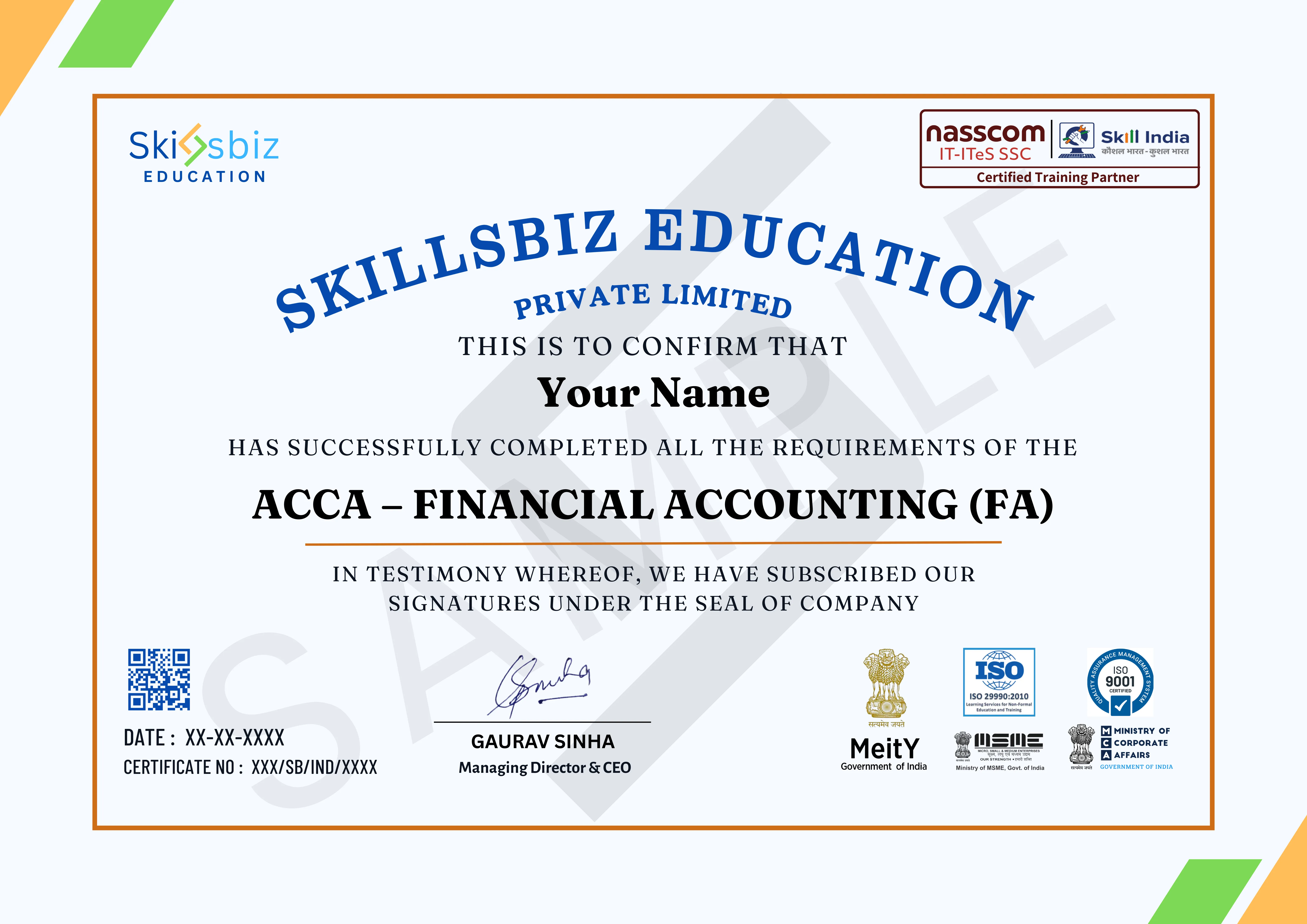
Your credential
The certificate you'll earn
Earn an industry-recognized certificate on successful completion of this program.
Personalised guidance
Book a free discovery call with our specialists
Get tailored advice on learning paths, certification journeys, and industry opportunities before you enroll.
- Understand the skill gaps holding you back and the modules that close them.
- Get a cohort recommendation based on availability and your weekly bandwidth.
- Discover certification add-ons that strengthen your CV.
Reserve your slot
Share your details and we'll connect within 24 hours.
Reviews
What our learners say
Learning FA gave me clarity on financial reporting basics. The structured approach helped me prepare confidently for the exam.
FA preparation helped me see how every transaction impacts financial statements. Step-by-step explanations made the subject less intimidating.
ACCA Financial Accounting helped me understand the basics of accounting in a very clear way. Preparing financial statements now feels organised and logical.
Understanding ledger postings and adjustments became easier with consistent guidance. Financial Accounting training strengthened my core accounting foundation.
FA preparation improved my confidence in preparing trial balances and final accounts. Working through practical questions made concepts easy to retain.
ACCA Financial Accounting helped me build a strong base in accounting principles. Understanding double-entry bookkeeping and financial statements became much clearer with regular practice.
FAQ
Your questions, answered
Everything you need to know before you enroll. Still unsure? Our advisors are one call away.
Honored for excellence
Awards & recognitions
Our pedagogy, learner outcomes, and mentor network have been acknowledged by industry councils and global forums.





Media spotlight
Featured in leading publications










Ready to start ACCA– Financial Accounting (FA)?
Enroll today or book a free counselling call to get a personalized learning path.