ACCA– Financial Management (FM)
This course offers an in-depth understanding of financial management principles essential for ACCA success.
Program rating
1,767+
Learners enrolled
70 hrs
Total duration
English,Hindi
Language
This program includes
Program overview
About this program
This Finance & Taxation program blends live, mentor-led sessions with hands-on projects and real-world case studies, so you build genuinely job-ready skills — not just theory. You'll learn from working industry experts, apply what you learn on practical assignments, and finish with a portfolio, a recognized certificate, and dedicated placement support to help you land the right role.
This course offers an in-depth understanding of financial management principles essential for ACCA success.
The ACCA Financial Management (FM) course is designed for those looking to gain a comprehensive understanding of the financial management process. It covers key concepts such as budgeting, cash flow management, investment decisions, and the analysis of financial statements. By the end of the course, participants will be equipped with the necessary skills to make informed financial decisions and enhance their career prospects in the finance sector.
Why learners love this program
- Syllabus-aligned exam preparation: focused coverage of budgeting, cash flow, investment appraisal, risk management, and financial statement analysis with exam techniques and practice questions.
- Practical decision-making skills: hands-on training in capital budgeting, working capital management, valuation and risk assessment to support real-world financial decisions.
- Applied learning and career readiness: case studies, financial modelling exercises, and tool-based practice to build practical skills for finance roles and ACCA examinations.
35
Lectures
70
Hours
All level
Level
Globally trusted accreditations
Recognitions that power your profile
Trusted by leading accreditation bodies — so your certificate is respected by employers worldwide.










Learning outcomes
What you'll be able to do
Curriculum
Structured modules that build real skills
17 modules · designed for progressive, hands-on learning.
Role of Financial Management
Explain the role and purpose of financial management within an organization.
Goals and Stakeholders
Describe key objectives such as wealth maximization and the interests of different stakeholders.
Financial Environment and Ethics
Summarize the regulatory, institutional and ethical context affecting financial decision-making.
Time Value of Money
Apply time value of money concepts to value cash flows and make basic financial comparisons.
Core Financial Concepts
Outline fundamental concepts including risk-return trade-off and capital allocation decisions.
Understanding Financial Statements
Identify and describe the components and purposes of the balance sheet, income statement and cash flow statement.
Interpreting Notes and Adjustments
Explain how notes and adjustments affect the interpretation of financial statements.
Limitations of Financial Statements
Recognize common limitations and the need for adjustments when analyzing reported figures.
Profitability Ratios
Calculate and interpret profitability ratios to evaluate company performance.
Liquidity and Solvency Ratios
Assess liquidity and long-term solvency using relevant financial ratios.
Cash Flow Statement Preparation
Prepare and classify cash flows from operating, investing and financing activities.
Cash Flow Assessment
Analyze cash flow patterns to assess liquidity and operational sustainability.
Principles of Budgeting
Explain the purpose of budgets and the role they play in planning and control.
Forecasting Techniques
Apply forecasting methods to project future revenues, costs and cash flows.
Variance Analysis
Perform variance analysis to compare actual outcomes with budgets and identify causes.
Zero-based and Flexible Budgets
Differentiate between zero-based, incremental and flexible budgeting approaches and their uses.
Rolling Forecasts and Sensitivity
Use rolling forecasts and sensitivity analysis to update plans and assess uncertainty.
Components of Cost of Capital
Identify the components of cost of capital and why each component matters for firms.
Estimating Cost of Debt and Equity
Estimate the cost of debt and cost of equity using market-based and analytical approaches.
Calculating WACC
Compute the weighted average cost of capital and understand its inputs.
Using WACC in Valuation
Apply WACC as a discount rate in project and firm valuation contexts.
Managing Cash and Liquidity
Assess cash needs and techniques for managing short-term liquidity effectively.
Inventory and Payables Management
Explain strategies for inventory control and supplier payment terms to optimize working capital.
Short-term Financing Options
Compare short-term financing instruments and their suitability for liquidity management.
Net Present Value and IRR
Apply NPV and IRR methods to evaluate investment projects and compare results.
Payback and Accounting Rate of Return
Use payback and accounting rate of return as complementary appraisal measures.
Real Options and Sensitivity Analysis
Incorporate real options and sensitivity analysis into project appraisal under uncertainty.
Project Risk Adjustments
Adjust appraisal outcomes for risk using discount rate adjustments and scenario analysis.
Sources of Finance
Describe various sources of finance including equity, debt and hybrid instruments.
Comparing Costs and Terms
Evaluate financing alternatives by comparing costs, covenants and impact on control.
Trade-off Theory and Leverage
Explain how capital structure affects firm value and the role of financial leverage.
Dividend Policy Implications
Discuss how dividend policy choices influence shareholder value and signaling effects.
Key Performance Indicators and Financial Metrics
Identify and use KPIs to measure financial performance and profitability.
Balanced Scorecard and Non-financial Measures
Integrate non-financial measures into performance assessment using the balanced scorecard.
Benchmarking and Trend Analysis
Conduct benchmarking and trend analysis to evaluate performance over time and against peers.
Identifying Financial Risks
Identify key financial risks including market, credit and liquidity risks.
Mitigation Strategies and Hedging
Describe strategies such as diversification, insurance and hedging to mitigate financial risks.
Exam Techniques and Time Management
Adopt effective exam techniques, time management and question-reading strategies for the ACCA FM exam.
Practice Questions and Revision Strategy
Use targeted practice questions and a structured revision plan to consolidate exam readiness.
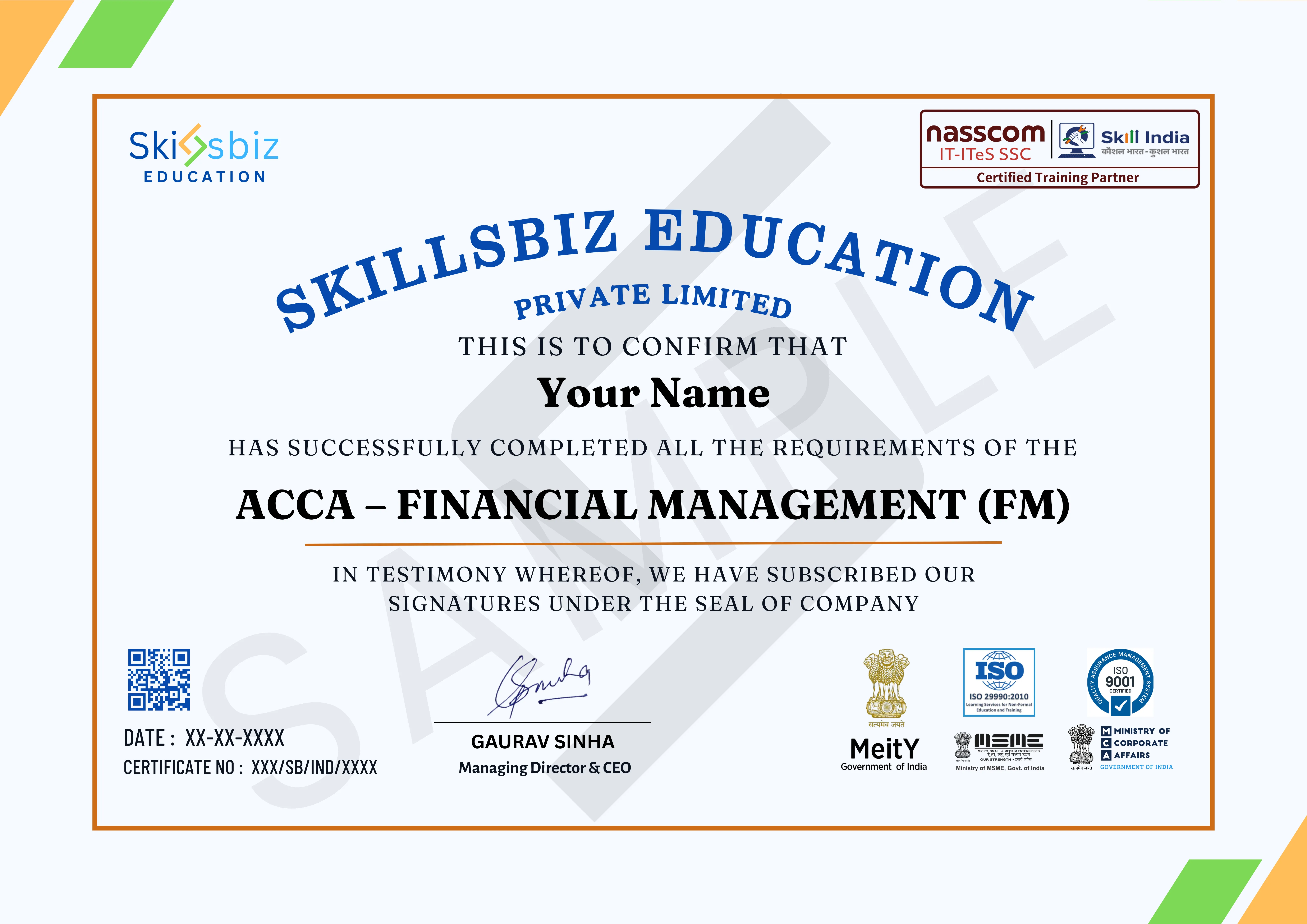
Your credential
The certificate you'll earn
Earn an industry-recognized certificate on successful completion of this program.
Personalised guidance
Book a free discovery call with our specialists
Get tailored advice on learning paths, certification journeys, and industry opportunities before you enroll.
- Understand the skill gaps holding you back and the modules that close them.
- Get a cohort recommendation based on availability and your weekly bandwidth.
- Discover certification add-ons that strengthen your CV.
Reserve your slot
Share your details and we'll connect within 24 hours.
Reviews
What our learners say
Learning working capital management gave me a better view of how companies manage short-term finances. Financial Management preparation felt practical.
FM sessions strengthened my understanding of cost of capital and business risk. Regular practice made complex calculations feel less intimidating.
ACCA Financial Management helped me understand investment decisions in a structured way. Practicing NPV and IRR questions improved both speed and clarity.
Understanding foreign exchange risk and hedging techniques became much easier after step-by-step guidance. FM preparation felt organised and practical.
FM preparation strengthened my understanding of risk management and cost of capital. Solving practical scenarios made complex financial formulas easier to apply.
ACCA Financial Management helped me understand investment appraisal and capital budgeting clearly. Working through NPV and IRR questions improved my confidence with financial decision-making.
FAQ
Your questions, answered
Everything you need to know before you enroll. Still unsure? Our advisors are one call away.
Honored for excellence
Awards & recognitions
Our pedagogy, learner outcomes, and mentor network have been acknowledged by industry councils and global forums.





Media spotlight
Featured in leading publications










Ready to start ACCA– Financial Management (FM)?
Enroll today or book a free counselling call to get a personalized learning path.