ACCA– Management Accounting (MA)
This course provides comprehensive knowledge of management accounting principles and practices.
Program rating
1,913+
Learners enrolled
70 hrs
Total duration
English,Hindi
Language
This program includes
Program overview
About this program
This Finance & Taxation program blends live, mentor-led sessions with hands-on projects and real-world case studies, so you build genuinely job-ready skills — not just theory. You'll learn from working industry experts, apply what you learn on practical assignments, and finish with a portfolio, a recognized certificate, and dedicated placement support to help you land the right role.
This course provides comprehensive knowledge of management accounting principles and practices.
Join our ACCA Management Accounting (MA) course to gain a deep understanding of management accounting concepts, techniques, and their application in decision-making processes. The course encompasses various topics, including budgeting, performance evaluation, and cost control, designed to equip you with essential skills for a successful career in finance and accounting.
Why learners love this program
- Comprehensive coverage of core MA topics: costing methods, budgeting, standard costing, variance analysis, and performance measurement.
- Exam-focused practical training: worked examples, past-paper practice, and techniques tailored to ACCA MA assessments.
- Decision-making and control skills: cost-volume-profit analysis, budgetary control, KPIs, and cost control for real-world financial management.
35
Lectures
70
Hours
All level
Level
Globally trusted accreditations
Recognitions that power your profile
Trusted by leading accreditation bodies — so your certificate is respected by employers worldwide.






Learning outcomes
What you'll be able to do
Curriculum
Structured modules that build real skills
17 modules · designed for progressive, hands-on learning.
What is Management Accounting?
Explain the purpose and scope of management accounting and how it supports internal decision-making.
Key Roles and Functions
Describe the primary roles and responsibilities of management accountants within organizations.
Organizational Context and Users
Identify the internal users of management accounting information and explain how context shapes reporting needs.
Value Creation and Strategic Support
Explain how management accounting contributes to value creation and strategic planning.
Cost Terminology and Elements
Define common cost terms and elements and explain their relevance to managerial analysis.
Fixed, Variable and Mixed Costs
Differentiate fixed, variable and mixed costs and describe their behavior in relation to activity levels.
Direct and Indirect Costs
Distinguish direct from indirect costs and explain implications for costing and decision-making.
Classification for Decision Making
Classify costs by purpose (e.g., product, period, controllable) to support managerial decisions.
Cost Tracing and Allocation Methods
Explain methods for tracing and allocating costs and assess their impact on product costing.
CVP Relationships and Assumptions
Explain cost-volume-profit relationships and the assumptions underlying CVP analysis.
Contribution Margin Analysis
Calculate and interpret contribution margin and use it to assess profitability of products or services.
Break-even and Margin of Safety
Compute break-even points and margin of safety and interpret their managerial implications.
Sensitivity and Scenario Analysis
Apply sensitivity and scenario techniques to evaluate how changes in variables affect profit outcomes.
Types of Budgets
Describe common budget types (e.g., operating, cash, capital) and when to use each.
Budget Preparation Techniques
Explain the steps and best practices in preparing realistic and achievable budgets.
Monitoring and Variance Reporting
Explain how budgetary control systems monitor performance and generate variance reports.
Flexible and Rolling Budgets
Describe flexible and rolling budgets and their use in dynamic business environments.
Setting Standards
Explain how standard costs are established and their role in planning and control.
Advantages and Limitations of Standards
Evaluate the benefits and limitations of standard costing systems in practice.
Material and Labour Variances
Calculate material and labour variances and interpret their causes and implications.
Overhead and Sales Variances
Analyse overhead and sales variances and recommend managerial responses to significant variances.
Designing Effective KPIs
Identify characteristics of effective KPIs and design measures aligned to strategic objectives.
Financial and Non-Financial Measures
Explain the role of both financial and non-financial measures in assessing performance.
Balanced Scorecard Framework
Describe the balanced scorecard and how it integrates different performance perspectives.
Benchmarking and Continuous Improvement
Explain benchmarking techniques and continuous improvement approaches to enhance performance.
Identifying Relevant Costs and Benefits
Identify which costs and benefits are relevant for specific short-term decisions such as accept/reject and outsourcing.
Make-or-Buy and Special Order Analysis
Apply relevant cost analysis to make-or-buy decisions and evaluate special order opportunities.
Net Present Value and Internal Rate of Return
Explain and calculate NPV and IRR and interpret their use in investment appraisal.
Payback Period and Accounting Rate of Return
Describe payback and ARR methods and assess their strengths and weaknesses compared with discounted techniques.
Assessing Project Cash Flows
Identify and forecast relevant cash flows for capital projects and account for taxation and working capital.
Risk Analysis in Capital Projects
Apply sensitivity, scenario and probabilistic techniques to assess project risk.
Types of Management Accounting Systems
Describe different management accounting systems and their features, including costing and reporting modules.
Information Flows and Reporting
Explain how accounting data is captured, processed and presented for managerial decision-making.
Ethical Principles for Management Accountants
Explain the key ethical principles and responsibilities of management accounting professionals.
Regulatory Compliance and Professional Conduct
Describe consequences of non-compliance and best practices for maintaining professional standards.
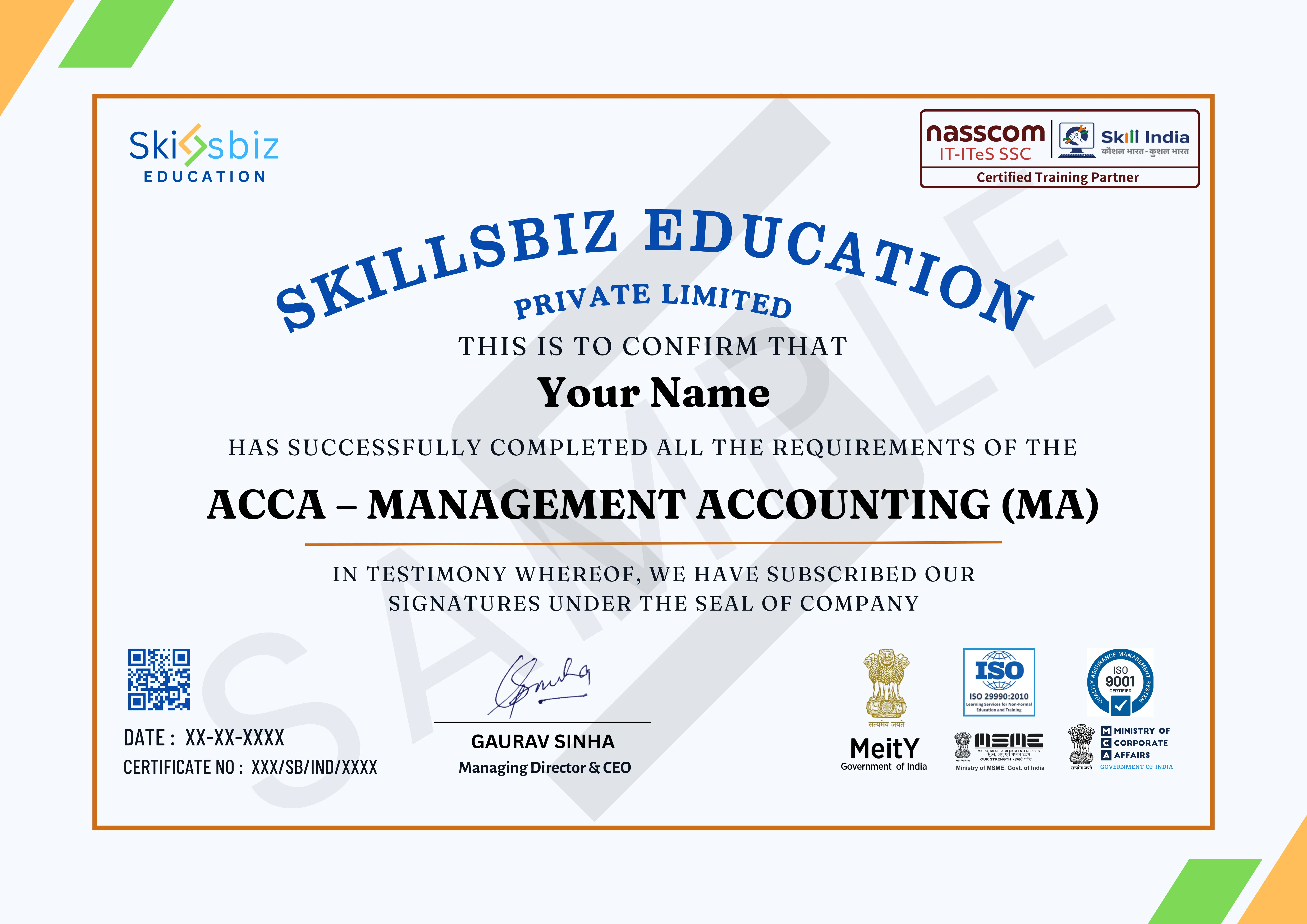
Your credential
The certificate you'll earn
Earn an industry-recognized certificate on successful completion of this program.
Personalised guidance
Book a free discovery call with our specialists
Get tailored advice on learning paths, certification journeys, and industry opportunities before you enroll.
- Understand the skill gaps holding you back and the modules that close them.
- Get a cohort recommendation based on availability and your weekly bandwidth.
- Discover certification add-ons that strengthen your CV.
Reserve your slot
Share your details and we'll connect within 24 hours.
Reviews
What our learners say
Management Accounting improved my ability to interpret financial data. Solving exam-style problems made me more confident.
Learning performance measurement and budgeting methods improved my analytical confidence. Regular question practice made calculations easier.
ACCA Management Accounting helped me connect costing techniques with real business scenarios. Break-even and budgeting concepts became much clearer with practice.
ACCA MA clarified how businesses control costs and measure efficiency. Practicing real exam-style questions helped me understand application better.
MA preparation strengthened my analytical thinking. Learning variance analysis and performance measurement made problem-solving much more structured.
ACCA Management Accounting helped me understand how costing and budgeting influence business decisions. Working through numericals on marginal and absorption costing improved my clarity a lot.
FAQ
Your questions, answered
Everything you need to know before you enroll. Still unsure? Our advisors are one call away.
Honored for excellence
Awards & recognitions
Our pedagogy, learner outcomes, and mentor network have been acknowledged by industry councils and global forums.




Media spotlight
Featured in leading publications










Ready to start ACCA– Management Accounting (MA)?
Enroll today or book a free counselling call to get a personalized learning path.