ACCA– Performance Management (PM)
This course provides a comprehensive overview of performance management principles and practices.
Program rating
1,949+
Learners enrolled
70 hrs
Total duration
English,Hindi
Language
This program includes
Program overview
About this program
This Finance & Taxation program blends live, mentor-led sessions with hands-on projects and real-world case studies, so you build genuinely job-ready skills — not just theory. You'll learn from working industry experts, apply what you learn on practical assignments, and finish with a portfolio, a recognized certificate, and dedicated placement support to help you land the right role.
This course provides a comprehensive overview of performance management principles and practices.
The ACCA Performance Management (PM) course is designed to equip students with the skills necessary to improve an organization's performance through effective performance management techniques. Explore budgeting, variance analysis, and performance indicators in depth.
Why learners love this program
- Budgeting and variance analysis — build flexible and functional budgets, analyze variances and recommend corrective actions to improve financial control.
- Performance measurement and KPIs — design, select and interpret financial and non-financial indicators (including balanced scorecard) to monitor organizational performance.
- Decision-making and performance improvement — apply costing methods, standard and marginal costing, and behavioural insights to support managerial decisions and drive performance.
35
Lectures
70
Hours
All level
Level
Globally trusted accreditations
Recognitions that power your profile
Trusted by leading accreditation bodies — so your certificate is respected by employers worldwide.










Learning outcomes
What you'll be able to do
Curriculum
Structured modules that build real skills
16 modules · designed for progressive, hands-on learning.
Concepts and Definitions
Define performance management and explain its core concepts and scope within organizations.
Objectives of Performance Management
Describe the primary objectives of performance management including improving efficiency and strategic alignment.
Stakeholders and Roles
Identify key stakeholders in performance management and outline their roles and responsibilities.
Performance Measurement Frameworks
Explain common frameworks used to measure performance and how they support decision making.
Strategic Alignment
Discuss how performance management links operational activities to strategic objectives.
Performance Management Cycle
Outline the stages of the performance management cycle from planning to review.
Historical Development and Trends
Summarize historical developments and current trends influencing performance management practice.
Ethics and Governance in Performance Management
Explain ethical considerations and governance requirements affecting performance measurement and reporting.
Assessment and Evaluation Methods
Describe methods used to assess performance including qualitative and quantitative approaches.
Purposes of Budgeting
Explain the purposes of budgeting in planning, control, and resource allocation.
Types of Budgets
Differentiate between common budget types such as fixed, flexible and rolling budgets.
Zero-Based Budgeting
Describe zero-based budgeting and when it is appropriate to use it.
Flexible Budgeting
Explain flexible budgeting and how it adjusts for changes in activity levels.
Rolling Budgets and Forecasting
Discuss rolling budgets and their role in continuous forecasting and updating.
Participative Budgeting
Describe participative budgeting and its effects on motivation and budget acceptance.
Behavioral Implications of Budgeting
Explain behavioral responses to budgeting and how they influence performance outcomes.
Budgeting and Strategy
Link budgeting practices to strategic objectives and resource prioritization.
Preparing Operational Budgets
Outline steps to prepare detailed operational budgets and ensure consistency across functions.
Nature of Variances
Define variance analysis and explain the significance of investigating variances.
Material Variances
Calculate and interpret material price and usage variances and their business implications.
Labor Variances
Explain labor rate and efficiency variances and how they inform workforce management.
Overhead Variances
Describe overhead spending and efficiency variances and methods to allocate overheads.
Sales and Margin Variances
Analyse sales volume and margin variances and their impact on profitability.
Variance Investigation
Outline procedures for investigating significant variances and identifying root causes.
Reporting Variances
Describe best practices for reporting variances to management for timely action.
Standard Costing Systems
Explain the role of standard costing in performance control and variance computation.
Using Variances for Control
Demonstrate how variance analysis supports corrective actions and continuous improvement.
KPI Selection Principles
Describe criteria for selecting effective KPIs that align with organizational goals.
Leading vs Lagging Indicators
Differentiate between leading and lagging indicators and their uses in performance management.
Financial KPIs
Identify key financial KPIs and explain how they measure financial performance.
Non-Financial KPIs
Explain non-financial KPIs and their importance in capturing operational performance.
Benchmarking and Targets
Discuss benchmarking methods and setting realistic KPI targets and thresholds.
Balanced Scorecard
Explain the balanced scorecard approach and how it integrates multiple performance perspectives.
KPI Dashboards and Reporting
Describe design principles for KPI dashboards and effective reporting formats.
KPI Review Processes
Outline processes for reviewing and updating KPIs in response to changing priorities.
Data Quality and KPI Reliability
Discuss the importance of data quality and controls to ensure reliable KPI measurement.
Components of a PMS
Describe the core components of a performance management system and their interactions.
Designing a PMS
Explain key design considerations when building a performance management system for an organization.
Implementation Planning
Outline steps to plan implementation and ensure stakeholder engagement and readiness.
Technology and Automation in PMS
Discuss how technology supports PMS through automation, data visualisation, and analytics.
Change Management for PMS
Explain change management techniques to support successful PMS adoption.
Integration with HR Systems
Describe how PMS integrates with HR processes such as appraisal, training and development.
Performance Appraisal Methods
Compare common appraisal methods and their suitability for different contexts.
Reward and Recognition Systems
Explain the role of reward systems in reinforcing desired performance behaviours.
Continuous Improvement and Feedback Loops
Describe mechanisms to embed continuous improvement and feedback within a PMS.
Control Environment and Policies
Explain how the control environment and policies set the tone for effective management control.
Budgetary Control as a Management Tool
Describe how budgetary control is used within management control systems to guide performance.
Administrative and Operational Controls
Identify administrative controls and operational procedures that support reliable performance.
Decentralization and Control
Discuss the impact of decentralization on control arrangements and manager accountability.
Responsibility Centres
Explain types of responsibility centres and how responsibility accounting supports control.
Transfer Pricing and Performance
Describe transfer pricing methods and their effect on divisional performance measurement.
Performance Measurement within MCS
Explain measurement approaches used in MCS to evaluate different organisational units.
Incentive and Reward Systems
Discuss how incentives are designed and aligned with performance objectives to motivate staff.
Evaluating MCS Effectiveness
Outline criteria and methods to evaluate the effectiveness of management control systems.
Cost-Volume-Profit Analysis
Apply cost-volume-profit analysis to inform pricing and production decisions.
Relevant Costing for Short-Term Decisions
Use relevant costing principles to make incremental and make-or-buy decisions.
Short-Term Decision Techniques
Explain techniques for short-term decisions including special orders and constrained resources.
Basics of Investment Appraisal
Describe the fundamentals of investment appraisal methods and their role in strategic decisions.
Profitability Ratios
Calculate and interpret profitability ratios to assess business performance.
Liquidity and Solvency Ratios
Explain liquidity and solvency ratios and their importance for financial stability analysis.
Efficiency and Activity Ratios
Use efficiency ratios to evaluate asset utilisation and operational effectiveness.
Identifying Risks to Performance
Identify common financial and non-financial risks that can affect organizational performance.
Quantifying Performance Risk
Explain approaches to quantify and prioritise risks that impact performance targets.
Mitigation Strategies
Describe strategies to mitigate identified risks and reduce their impact on performance.
Internal Controls and Risk Management
Explain the role of internal controls in managing risk within performance management systems.
Monitoring and Reporting Risk
Outline processes for ongoing monitoring and reporting of performance-related risks.
Case Study: Budgeting in Practice
Analyse a real-life budgeting case and extract lessons on planning and control.
Case Study: Variance Analysis Application
Work through a variance analysis case to interpret causes and recommend actions.
Case Study: KPI Implementation
Evaluate a KPI implementation case and assess success factors and pitfalls.
Course Review and Exam Preparation
Summarise key course concepts and provide targeted preparation for assessment and exams.
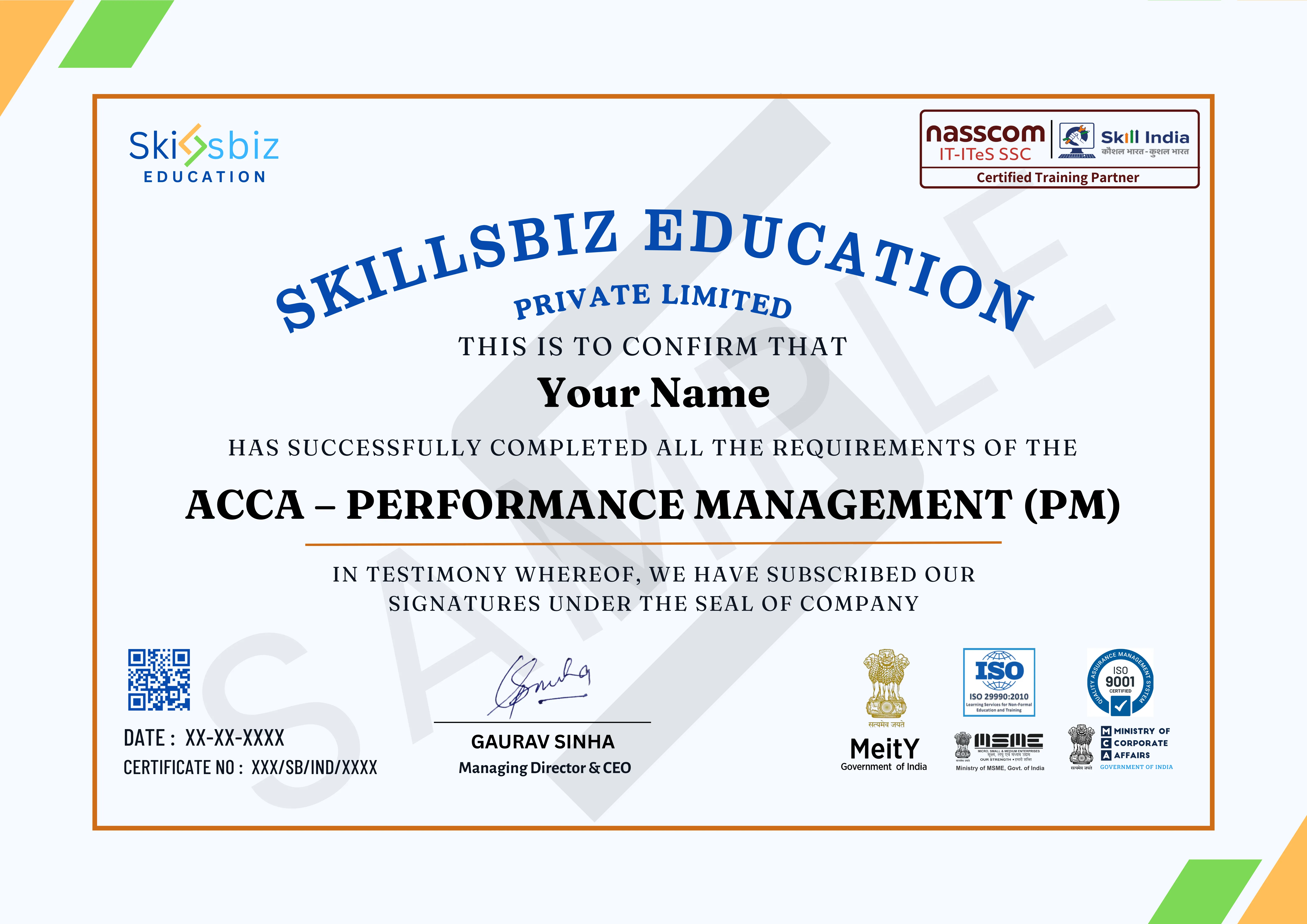
Your credential
The certificate you'll earn
Earn an industry-recognized certificate on successful completion of this program.
Personalised guidance
Book a free discovery call with our specialists
Get tailored advice on learning paths, certification journeys, and industry opportunities before you enroll.
- Understand the skill gaps holding you back and the modules that close them.
- Get a cohort recommendation based on availability and your weekly bandwidth.
- Discover certification add-ons that strengthen your CV.
Reserve your slot
Share your details and we'll connect within 24 hours.
Reviews
What our learners say
Performance Management training improved my clarity on strategic planning and KPIs. Practice sessions made calculations easier to handle.
PM sessions clarified how variance analysis works in real business situations. The exam-focused approach made revision easier.
ACCA Performance Management helped me understand how budgeting and forecasting support business decisions. Regular practice improved my numerical confidence.
Understanding advanced variance analysis and decision-making techniques became easier with structured practice. Performance Management sessions felt detailed and exam-focused.
PM preparation strengthened my analytical skills significantly. Learning how to interpret budgets and evaluate operational efficiency improved my confidence.
ACCA Performance Management helped me understand how businesses measure and improve performance. Working on variance analysis and performance metrics made concepts very practical.
FAQ
Your questions, answered
Everything you need to know before you enroll. Still unsure? Our advisors are one call away.
Honored for excellence
Awards & recognitions
Our pedagogy, learner outcomes, and mentor network have been acknowledged by industry councils and global forums.




Media spotlight
Featured in leading publications










Ready to start ACCA– Performance Management (PM)?
Enroll today or book a free counselling call to get a personalized learning path.