ACCA– Taxation (TX)
Master the principles of taxation with our comprehensive ACCA Taxation (TX) course. Ideal for aspiring accountants.
Program rating
1,789+
Learners enrolled
70 hrs
Total duration
English,Hindi
Language
This program includes
Program overview
About this program
This Finance & Taxation program blends live, mentor-led sessions with hands-on projects and real-world case studies, so you build genuinely job-ready skills — not just theory. You'll learn from working industry experts, apply what you learn on practical assignments, and finish with a portfolio, a recognized certificate, and dedicated placement support to help you land the right role.
Master the principles of taxation with our comprehensive ACCA Taxation (TX) course. Ideal for aspiring accountants.
This course provides an in-depth understanding of the main principles and regulations of taxation. It covers key topics such as income tax, value-added tax (VAT), and corporate tax in a structured way to ensure you gain the requisite knowledge and skills to pass the ACCA Taxation (TX) exam.
Why learners love this program
- Complete syllabus coverage: detailed modules on income tax, VAT, and corporate tax aligned to the ACCA TX exam requirements.
- Exam-focused preparation: practice questions, past-paper walkthroughs, model answers and examiner techniques to improve performance under timed conditions.
- Practical application and updates: real-world case studies, worked examples and regular updates on tax law changes to ensure up-to-date knowledge.
35
Lectures
70
Hours
All level
Level
Globally trusted accreditations
Recognitions that power your profile
Trusted by leading accreditation bodies — so your certificate is respected by employers worldwide.









Learning outcomes
What you'll be able to do
Curriculum
Structured modules that build real skills
17 modules · designed for progressive, hands-on learning.
Purpose and Principles of Taxation
Explain the economic and social purposes of taxation and outline core taxation principles. Identify how taxation supports public finance and redistribution.
Types of Taxes and Tax Systems
Describe major tax types (direct and indirect) and compare common tax systems. Recognize how different systems affect taxpayers and revenue generation.
Income Sources and Taxpayer Residency
Identify different sources of income and explain residency rules for tax purposes. Assess how residency affects tax liability.
Taxable and Non-Taxable Income
Differentiate between taxable and exempt income and list typical non-taxable items. Apply these distinctions when determining taxable income.
Allowable Deductions and Reliefs
Explain common deductions and reliefs available to individuals and when they apply. Calculate taxable income after applying allowable deductions.
Tax Rates and Liability Calculation
Apply applicable tax rates to compute tax liability for different income bands. Demonstrate rounding and aggregation rules used in calculations.
Practical Computation Exercises
Work through structured examples to compute taxable income and tax due. Reinforce computation skills under timed, exam-style conditions.
Corporate Tax Principles
Outline the basis of corporate taxation and how taxable profits are determined. Identify key adjustments from accounting profit to taxable profit.
Tax Treatment of Business Expenses
Classify allowable and disallowable business expenses and understand capital allowances. Apply rules to determine deductible expenses for corporations.
Sole Traders and Partnerships vs Corporations
Compare tax implications of different business structures and the tax liabilities they incur. Assess factors affecting choice of structure from a tax perspective.
Transactions, Dividends and Distributions
Explain tax consequences of transactions between companies and shareholders, including dividends. Determine tax effects of distributions and retained earnings.
VAT Concepts and Scope
Define VAT, taxable supplies, and the scope of VAT registration. Distinguish between standard-rated, zero-rated and exempt supplies.
VAT Invoices and Records
Identify VAT invoice requirements and record-keeping obligations for VAT-registered businesses. Explain the role of documentation in VAT recovery.
Output and Input VAT Calculation
Compute output VAT due and input VAT recoverable in practical scenarios. Apply partial exemption and apportionment where applicable.
VAT Filing, Payments and Penalties
Explain VAT return procedures, deadlines and common penalties for non-compliance. Prepare simplified VAT return entries from transaction data.
Chargeable Gains and Disposal Rules
Define disposals and chargeable gains and apply the rules for calculating gains on disposal of assets. Identify cost base and allowable deductions.
Computation of Capital Gains
Compute gains or losses on assets accounting for indexation, costs and allowable deductions. Apply rollover and replacement reliefs where relevant.
Exemptions and Reliefs Overview
Summarize common exemptions and reliefs such as principal private residence relief and entrepreneurs' relief. Determine eligibility criteria for each relief.
Practical Application of Reliefs
Apply exemptions and reliefs to worked examples and compute post-relief tax outcomes. Evaluate planning opportunities related to capital gains.
Tax Return Preparation
Explain the components of individual and corporate tax returns and required supporting information. Complete sample return entries for common scenarios.
Payment Schedules and Instalments
Describe payment deadlines, instalment arrangements and collection methods. Calculate due dates and penalties for late payments.
Compliance Obligations and Record Keeping
Outline taxpayer responsibilities for record keeping, registration and reporting. Assess the consequences of non-compliance for businesses and individuals.
Investigations and Dispute Resolution
Describe the process of tax audits, investigations and dispute resolution mechanisms. Explain appeal rights and procedures for resolving assessments.
Residence, Source and Permanent Establishment
Distinguish between residence and source taxation and define permanent establishment. Apply these concepts to determine where profits are taxable.
Transfer Pricing Basics
Introduce transfer pricing principles and the arm's length concept. Recognize documentation requirements and adjustments for related-party transactions.
Double Taxation Relief
Explain methods of relief from double taxation including tax credits and exemptions. Apply treaty provisions to prevent double taxation in examples.
Withholding Taxes and Treaty Benefits
Identify common withholding taxes and how treaties modify them. Determine eligibility for treaty benefits and reduced rates.
Personal Tax Planning Techniques
Explore legitimate tax planning strategies for individuals including timing and income splitting. Evaluate ethical and legal considerations of planning choices.
Use of Reliefs and Allowances
Apply personal allowances and reliefs to reduce tax liabilities and optimize outcomes. Work through examples to demonstrate effective use of allowances.
Corporate Tax Planning Strategies
Assess tax-efficient structures and strategies for businesses including capital allowances and loss utilization. Consider compliance and reputational risks.
Timing and Transactional Planning
Evaluate timing strategies and transactional approaches to minimize tax costs. Analyze real-life scenarios to recommend tax-efficient solutions.
Legislative Updates and Policy Changes
Summarize recent changes in tax legislation and their practical implications. Interpret how policy shifts affect common tax positions.
Implications for Practice and Compliance
Assess how recent developments change compliance requirements and planning strategies. Recommend actions for practitioners to remain compliant.
Comprehensive Topic Review
Review and consolidate key concepts across all modules through focused summaries. Identify and address common areas of weakness ahead of assessment.
Mock Exam and Feedback
Complete a timed mock exam covering syllabus areas and receive structured feedback. Develop an exam technique plan based on performance.
Your credential
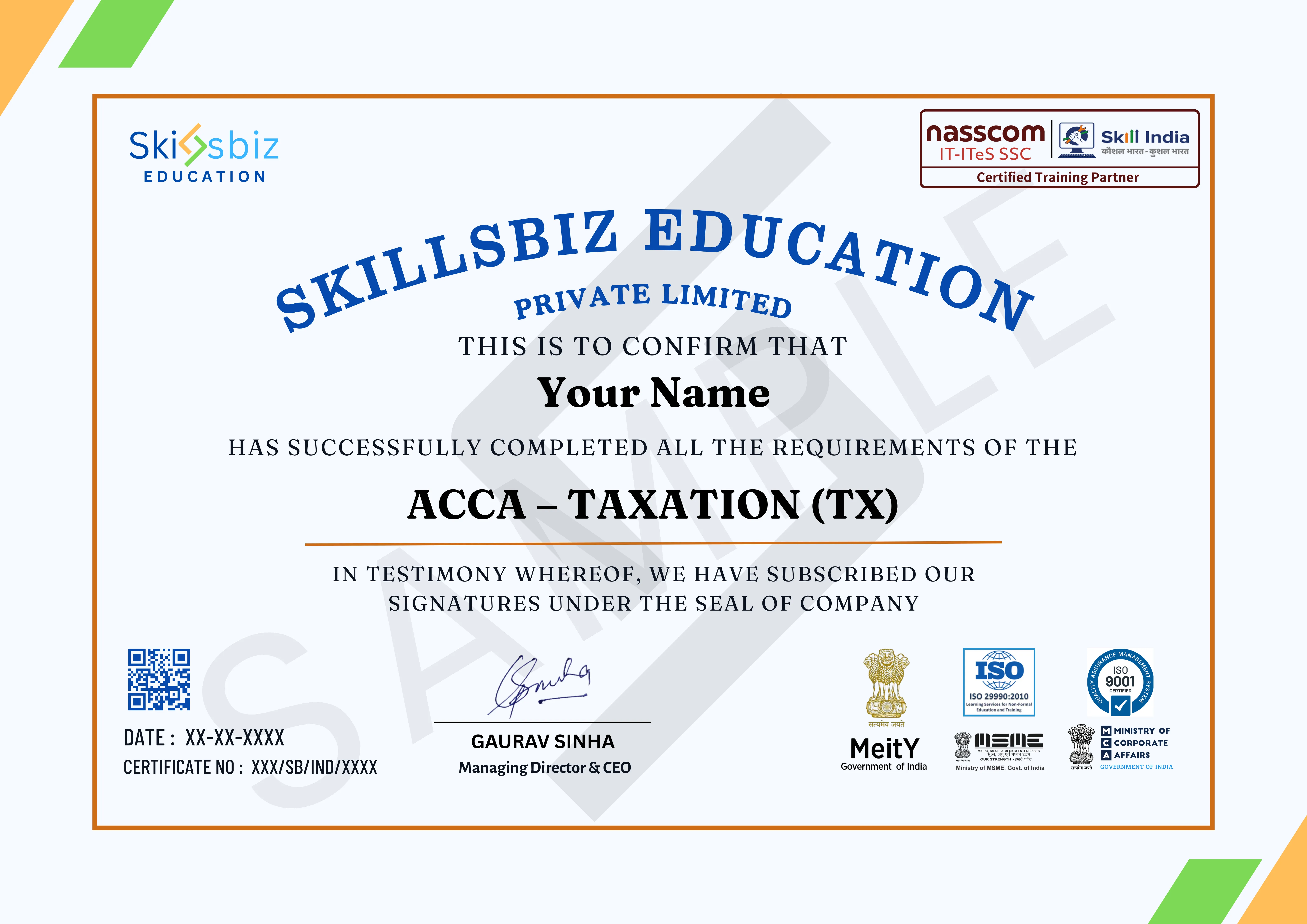
The certificate you'll earn
Earn an industry-recognized certificate on successful completion of this program.
Personalised guidance
Book a free discovery call with our specialists
Get tailored advice on learning paths, certification journeys, and industry opportunities before you enroll.
- Understand the skill gaps holding you back and the modules that close them.
- Get a cohort recommendation based on availability and your weekly bandwidth.
- Discover certification add-ons that strengthen your CV.
Reserve your slot
Share your details and we'll connect within 24 hours.
Reviews
What our learners say
Taxation preparation improved my clarity on tax liabilities and exemptions. Practicing real exam-style questions made a big difference.
TX sessions strengthened my calculation speed and accuracy. Understanding allowances and adjustments became much simpler with practice.
ACCA Taxation helped me build clarity in income tax and corporation tax topics. Breaking down each computation into smaller steps made learning easier.
Understanding tax adjustments and exemptions became easier through detailed explanations. TX preparation felt organised and very exam-focused.
TX preparation strengthened my ability to calculate liabilities accurately. Understanding allowances and reliefs step by step made complex tax rules manageable.
ACCA Taxation helped me understand how different taxes apply in real-life business scenarios. Working through income tax and corporate tax computations made the subject much clearer.
FAQ
Your questions, answered
Everything you need to know before you enroll. Still unsure? Our advisors are one call away.
Honored for excellence
Awards & recognitions
Our pedagogy, learner outcomes, and mentor network have been acknowledged by industry councils and global forums.





Media spotlight
Featured in leading publications










Ready to start ACCA– Taxation (TX)?
Enroll today or book a free counselling call to get a personalized learning path.