Advanced Diploma in Data Analytics
Enhance your career with our Advanced Diploma in Data Analytics. Learn essential skills and tools in data analysis over a comprehensive 148-hour course.
Program rating
5,000+
Learners enrolled
148 hrs
Total duration
English,Hindi
Language
This program includes
Program overview
About this program
This Data Analyst program blends live, mentor-led sessions with hands-on projects and real-world case studies, so you build genuinely job-ready skills — not just theory. You'll learn from working industry experts, apply what you learn on practical assignments, and finish with a portfolio, a recognized certificate, and dedicated placement support to help you land the right role.
Enhance your career with our Advanced Diploma in Data Analytics. Learn essential skills and tools in data analysis over a comprehensive 148-hour course.
The Advanced Diploma in Data Analytics is designed for professionals seeking to deepen their understanding of data analytics and its application in various fields.
This course covers key concepts including statistical analysis, data visualization, predictive modeling, and the use of analytics tools. Participants will engage in real-world projects that enable them to apply their learning in practical scenarios.
Globally trusted accreditations
Recognitions that power your profile
Trusted by leading accreditation bodies — so your certificate is respected by employers worldwide.










Curriculum
Structured modules that build real skills
18 modules · designed for progressive, hands-on learning.
What is Data Analytics?
Define data analytics and identify its core components and applications across industries.
Types of Data and Analytical Approaches
Distinguish between structured and unstructured data and compare descriptive, diagnostic, predictive, and prescriptive analytics.
The Analytics Value Chain
Describe the stages from data collection to decision-making and explain how analytics creates value.
Key Roles and Stakeholders
Identify common roles in analytics projects and outline stakeholder responsibilities and collaboration practices.
Problem Framing and Hypothesis
Formulate business questions into analytical problems and develop testable hypotheses.
Data Sourcing and Governance
Explain methods for sourcing relevant data and the basics of data governance and stewardship.
Project Planning and Agile Analytics
Apply project planning techniques and agile principles for iterative analytics delivery.
Measuring Impact and ROI
Define metrics to evaluate analytics outcomes and calculate basic return on investment for projects.
Summarizing Data
Compute and interpret measures of central tendency and dispersion for different data types.
Data Distributions and Visualization
Recognize common distributions and use visual summaries to communicate data characteristics.
Correlation and Association
Measure and interpret relationships between variables using correlation and cross-tabulation.
Probability Basics
Understand fundamental probability concepts that underpin statistical reasoning.
Sampling and Estimation
Explain sampling methods and compute point estimates and confidence intervals for population parameters.
Hypothesis Testing
Perform hypothesis tests and interpret p-values and Type I/II errors in decision contexts.
ANOVA and Categorical Tests
Apply ANOVA and chi-square tests to compare group differences and categorical associations.
Regression Foundations
Introduce simple linear regression and interpret coefficients, goodness-of-fit, and assumptions.
Statistical Power and Sample Size
Assess statistical power and determine sample size considerations for study design.
Visualization Design Fundamentals
Apply principles of effective visual encoding, color use, and chart selection for clear communication.
Telling Stories with Data
Structure narratives around data to support insights and persuasive communication.
Visualizing Uncertainty
Represent uncertainty and variability in visualizations to avoid misleading interpretations.
Accessibility and Ethical Visualization
Design visuals that are accessible and ethically represent data without distortion.
Introduction to Visualization Tools
Compare common tools (e.g., Tableau, Power BI, Python libraries) and their typical use cases.
Dashboard Design and KPI Tracking
Design dashboards that surface key performance indicators and support operational decision-making.
Interactive Visualizations
Implement interactivity concepts to enable exploration and drill-down analysis.
Performance and Data Refresh Strategies
Plan for dashboard performance, data refresh approaches, and data source management.
Data Ingestion Techniques
Describe methods to ingest data from varied sources and handle schema differences.
Parsing and Transformations
Apply parsing and transformation techniques to normalize and structure raw data for analysis.
Merging and Joining Datasets
Perform joins and merges while managing keys, duplicates, and mismatches.
Data Provenance and Lineage
Track data lineage and document transformations to ensure reproducibility and trust.
Handling Missing Data
Diagnose patterns of missingness and apply appropriate imputation or exclusion strategies.
Outliers and Anomaly Treatment
Detect outliers and decide on methods for treatment based on analytical impact.
Feature Engineering Basics
Create new features through aggregation, encoding, and transformation to improve model performance.
Data Quality Assessment
Establish quality checks and validation routines to ensure dataset reliability.
Linear and Logistic Regression
Build and interpret linear and logistic regression models for prediction tasks.
Tree-based Methods
Explain decision trees and ensemble methods such as random forests and their strengths.
Model Tuning and Hyperparameters
Perform hyperparameter tuning using grid search and cross-validation to optimize models.
Imbalanced Classes and Sampling
Address class imbalance with resampling and algorithmic approaches to improve classifier performance.
Time Series and Sequential Prediction
Apply basic time series forecasting methods and recognize when sequence-aware models are required.
Evaluation Metrics for Regression and Classification
Select and compute appropriate metrics such as RMSE, MAE, accuracy, precision, recall, and AUC.
Cross-Validation Strategies
Implement cross-validation techniques and understand their role in assessing generalization.
Bias-Variance Tradeoff
Explain overfitting and underfitting and apply strategies to balance bias and variance.
Model Interpretability
Use interpretability tools and techniques to explain model predictions to stakeholders.
Supervised Learning Workflow
Outline the supervised learning process from data splitting to model deployment.
Feature Selection and Regularization
Apply feature selection methods and regularization to improve model robustness.
Evaluation and Error Analysis
Conduct error analysis to identify model weaknesses and guide improvements.
Model Deployment Basics
Describe common approaches for deploying predictive models into production environments.
Clustering Techniques
Apply clustering algorithms and evaluate cluster quality for segmentation tasks.
Dimensionality Reduction
Use PCA and other techniques to reduce dimensionality while preserving signal.
Advanced Feature Engineering
Develop domain-specific features and pipelines to enhance model input quality.
Unsupervised Evaluation and Use Cases
Assess unsupervised models and identify practical applications in analytics workflows.
Big Data Principles
Explain the characteristics of big data and when specialized technologies are required.
Storage and Data Lakes
Differentiate storage architectures, including data lakes and warehouses, and their trade-offs.
Processing Paradigms
Compare batch and stream processing approaches and their typical use cases.
Cloud Platforms for Analytics
Identify key cloud services and architectures that enable scalable analytics solutions.
Defining Project Scope
Translate a business problem into a scoped capstone project with clear objectives and deliverables.
Data Requirements and Acquisition
Identify required data sources and plan acquisition, ensuring ethical and legal compliance.
Project Timeline and Milestones
Develop a project timeline with milestones and risk mitigation strategies.
Team Roles and Collaboration
Assign roles and set up collaboration processes for effective project execution.
Data Preparation for the Capstone
Execute data cleaning and transformation steps tailored to the project dataset.
Feature Engineering and Selection
Develop and select features that directly support the project modeling goals.
Model Building and Validation
Build predictive models and validate them using appropriate evaluation frameworks.
Iteration and Refinement
Iteratively refine models and data pipelines based on evaluation and stakeholder feedback.
Communicating Results
Prepare clear presentations and visualizations that convey project findings and recommendations.
Deployment Considerations
Plan practical steps for deploying project outcomes, including monitoring and maintenance.
Ethical and Legal Review
Conduct a review of ethical, privacy, and compliance considerations relevant to the project.
Reflection and Lessons Learned
Document lessons learned and identify opportunities for future improvement and scaling.
Privacy and Data Protection
Understand privacy principles and apply data protection best practices in analytics projects.
Bias, Fairness and Accountability
Identify sources of bias, evaluate fairness, and design accountable analytics processes.
Transparent and Responsible Reporting
Adopt transparency practices in reporting methods and limitations to stakeholders.
Regulatory and Ethical Frameworks
Apply relevant regulations and ethical frameworks to guide responsible analytics work.
Landscape of Roles and Skills
Map common career paths and the skills required for roles such as analyst, scientist, and engineer.
Building a Professional Portfolio
Create a portfolio of projects and artifacts that demonstrate practical analytics capabilities.
Interview Preparation and Networking
Prepare for technical and behavioral interviews and use networking strategies to find opportunities.
Continuous Learning and Certification Paths
Plan continued learning pathways and evaluate certifications and advanced study options.
Personalised guidance
Book a free discovery call with our specialists
Get tailored advice on learning paths, certification journeys, and industry opportunities before you enroll.
- Understand the skill gaps holding you back and the modules that close them.
- Get a cohort recommendation based on availability and your weekly bandwidth.
- Discover certification add-ons that strengthen your CV.
Reserve your slot
Share your details and we'll connect within 24 hours.
Reviews
What our learners say
I joined HR Analytics with Skillsbiz to upgrade my skills in data-driven HR practices. The trainer explained concepts like workforce planning, attrition analysis, and performance metrics in a very structured way. The hands-on sessions using...
I enrolled for PMP training with Skillsbiz and the experience was excellent. The trainer explained concepts like project lifecycle, risk management, and stakeholder handling in a very practical way. The mock tests and study material were ve...
I did Lean Six Sigma Green Belt with Skillsbiz. The training material was clear, and the online sessions were interactive with live case studies. I was able to use Lean tools in my company and my process improvement project got recognized b...
SAP HR module training was very detailed. I liked the practical approach and the way the trainer explained HR processes in SAP. The course gave me the clarity and confidence I was missing earlier. I strongly recommend Skillsbiz to anyone se...
I took up the GST certification course at Skillsbiz and it was very helpful. The trainer explained GST concepts clearly and also taught filing procedures with practical demonstrations. This course has given me confidence to handle GST in my...
I joined Digital Marketing to upgrade my skills and it was the best decision. The trainers were actual industry experts, not just lecturers. They shared real-life examples of campaigns and strategies. I especially found the SEO and social m...
I joined German B1 and I am very happy with the experience. The course structure was systematic, with grammar, vocabulary, and a lot of speaking practice. What I liked most was the personal attention given to every student. Now I am prepari...
I completed French A1 and A2 levels with Skillsbiz. The trainer was very patient and made classes interactive with role-plays, videos, and practice conversations. I was initially hesitant to speak, but now I can confidently hold basic conve...
I opted for Six Sigma Black Belt and the journey was very smooth. The curriculum was detailed, the trainer had deep industry knowledge, and the Skillsbiz support team helped me throughout. I cleared my certification in the first attempt, an...
FAQ
Your questions, answered
Everything you need to know before you enroll. Still unsure? Our advisors are one call away.
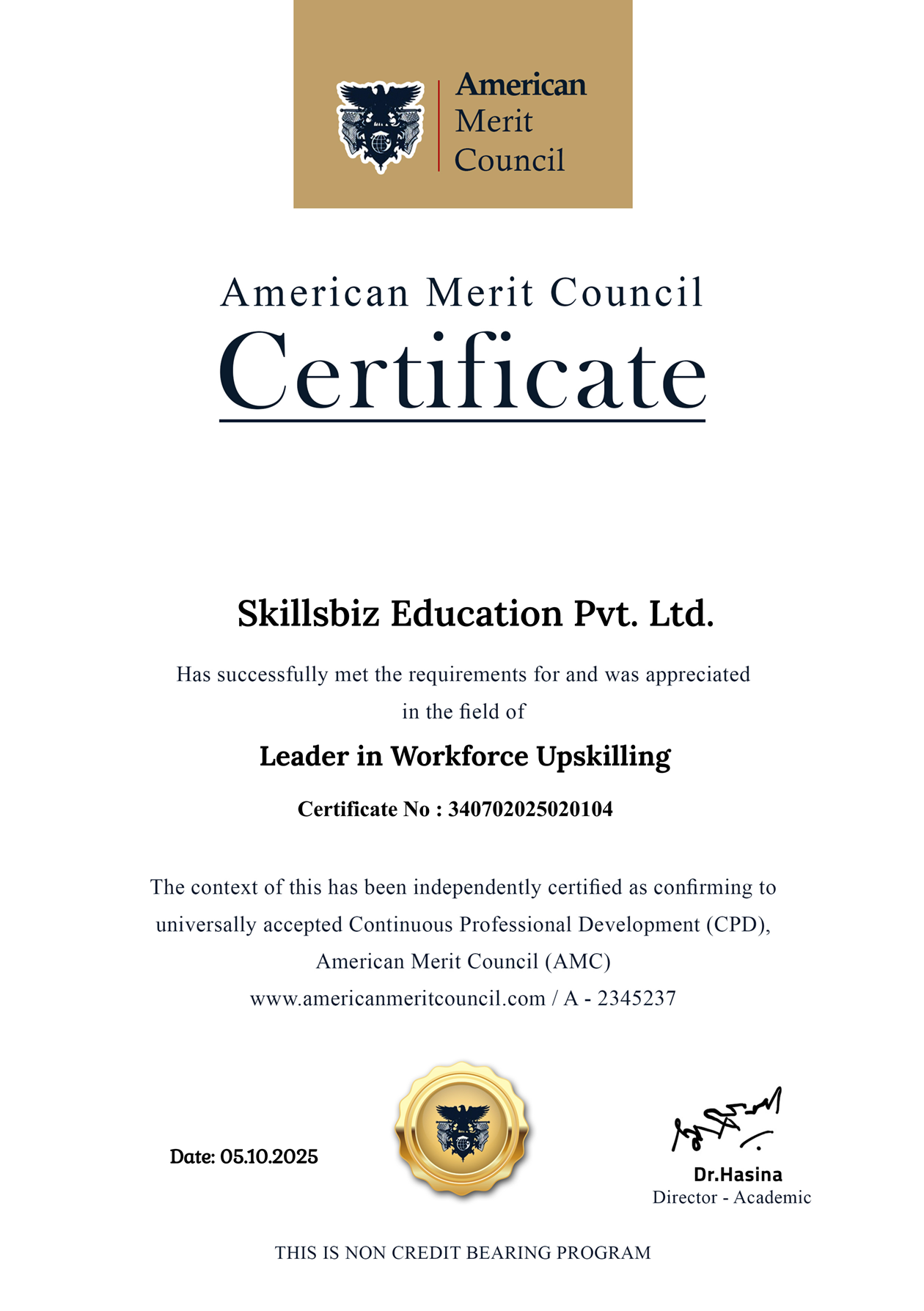
Honored for excellence
Awards & recognitions
Our pedagogy, learner outcomes, and mentor network have been acknowledged by industry councils and global forums.




Media spotlight
Featured in leading publications










Ready to start Advanced Diploma in Data Analytics?
Enroll today or book a free counselling call to get a personalized learning path.