Lean Six Sigma Black Belt Certification & Training
Master the methodologies of Lean Six Sigma and elevate your career with our Black Belt training.
Program rating
1,949+
Learners enrolled
32 hrs
Total duration
English,Hindi
Language
This program includes

Program overview
About this program
This Quality & Process Improvement program blends live, mentor-led sessions with hands-on projects and real-world case studies, so you build genuinely job-ready skills — not just theory. You'll learn from working industry experts, apply what you learn on practical assignments, and finish with a portfolio, a recognized certificate, and dedicated placement support to help you land the right role.
Master the methodologies of Lean Six Sigma and elevate your career with our Black Belt training.
This course is designed for professionals looking to deepen their understanding of Lean Six Sigma principles and practices to drive quality improvement and operational excellence.
Why learners love this program
- Comprehensive DMAIC and Lean methodology training — deep coverage of Define, Measure, Analyze, Improve, Control plus waste reduction techniques.
- Practical, project-based learning with mentor support — complete a real-world improvement project to apply skills and qualify for certification.
- Advanced statistical tools and leadership development — hands-on use of statistical analysis (e.g., Minitab, DOE, regression), process capability, and change-management skills.
20
Lectures
32
Hours
All level
Level
Globally trusted accreditations
Recognitions that power your profile
Trusted by leading accreditation bodies — so your certificate is respected by employers worldwide.






Learning outcomes
What you'll be able to do
Curriculum
Structured modules that build real skills
10 modules · designed for progressive, hands-on learning.
Overview of Lean Principles
Describe the core Lean principles and how they eliminate waste to improve flow.
Overview of Six Sigma Principles
Explain Six Sigma methodology, the DMAIC framework, and the role of statistical thinking in quality improvement.
Defining Project Goals
Construct clear project charters that state objectives, scope, and expected benefits.
Voice of the Customer and CTQ
Identify customer requirements and translate them into Critical-to-Quality (CTQ) metrics.
Stakeholder Analysis and Team Formation
Map stakeholders and form project teams with defined roles and responsibilities.
Process Mapping and Measurement Plan
Develop process maps and measurement plans to capture baseline performance and relevant metrics.
Data Collection and Measurement Systems
Implement data collection methods and assess measurement system capability and reliability.
Root Cause Analysis Techniques
Apply tools like 5 Whys and fishbone diagrams to uncover underlying causes of defects.
Process Performance Analysis
Use capability analysis and control charts to evaluate process stability and performance.
Hypothesis Testing Fundamentals
Formulate and test hypotheses to validate suspected root causes using statistical tests.
Failure Modes and Effects Analysis (FMEA)
Perform FMEA to prioritize risks and identify mitigation strategies.
Generating and Selecting Improvements
Design improvement solutions using brainstorming, prioritization, and pilot testing.
Lean Improvement Techniques
Apply Lean methods such as Kaizen and 5S to reduce waste and improve process flow.
Control Plans and Standardization
Create control plans and standard operating procedures to sustain improvements.
Statistical Process Control (SPC)
Use SPC charts to monitor process performance and detect special cause variation.
Handover and Continuous Improvement
Establish handover processes and continuous improvement loops to maintain gains.
Project Planning and Tracking
Utilize Gantt charts and milestone tracking to manage project timelines and deliverables.
Risk and Resource Management
Identify project risks and allocate resources effectively to ensure successful execution.
Descriptive Statistics and Data Visualization
Summarize process data using descriptive statistics and visualizations to reveal patterns and issues.
Regression and Correlation Analysis
Apply regression and correlation techniques to quantify relationships between variables.
Design of Experiments (DOE) Basics
Understand DOE principles to plan experiments that identify factor effects on process outputs.
Value Stream Mapping
Map end-to-end value streams to identify bottlenecks and opportunities for flow improvement.
5S and Workplace Organization
Implement 5S and workplace organization methods to improve safety, efficiency, and quality.
Exam Content Review
Review key concepts across DMAIC, Lean tools, and statistical methods likely tested on the Black Belt exam.
Practice Exams and Question Strategies
Complete practice exams and learn time-management and question-solving techniques for certification success.
Study Plan and Continuing Development
Develop a personalized study plan and identify resources for ongoing skill development post-certification.
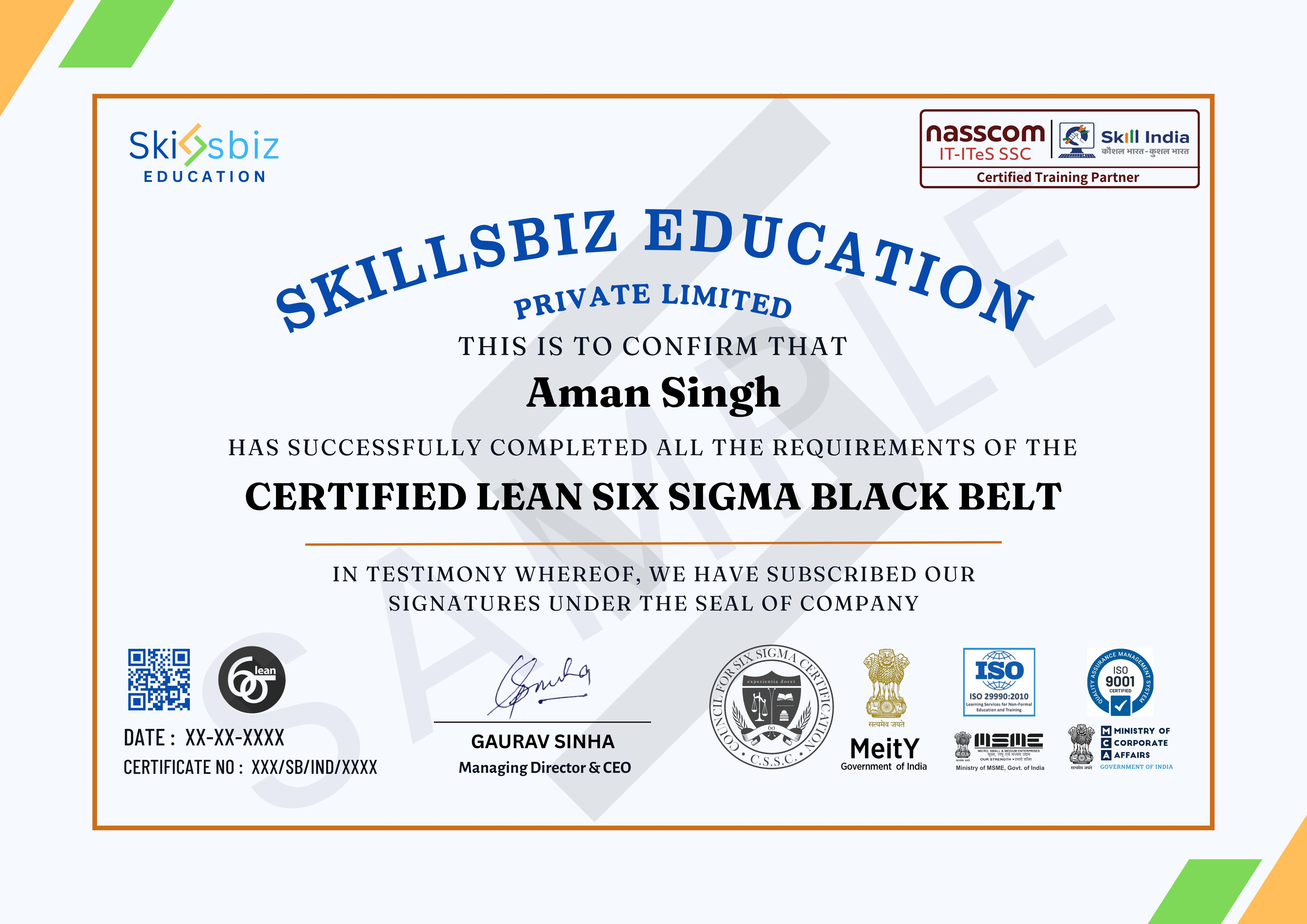
Your credential
The certificate you'll earn
Earn an industry-recognized certificate on successful completion of this program.
Personalised guidance
Book a free discovery call with our specialists
Get tailored advice on learning paths, certification journeys, and industry opportunities before you enroll.
- Understand the skill gaps holding you back and the modules that close them.
- Get a cohort recommendation based on availability and your weekly bandwidth.
- Discover certification add-ons that strengthen your CV.
Reserve your slot
Share your details and we'll connect within 24 hours.
Reviews
What our learners say
Understanding advanced statistics improved how I evaluate business performance. Black Belt training made me comfortable handling complex data-driven challenges.
Six Sigma Black Belt improved my ability to guide teams using data instead of assumptions. Complex problems now feel manageable through structured methodologies.
Advanced hypothesis testing and regression analysis became much clearer through real cases. Black Belt training strengthened my analytical and mentoring skills significantly.
The Lean Six Sigma Black Belt course at Skillsbiz was very comprehensive. The trainer explained complex statistical concepts step by step and made them easy to understand. The case studies were extremely valuable.
This course gave me both technical knowledge and leadership skills. The focus on DMAIC, control charts, and root cause analysis was excellent. It has boosted my confidence to lead quality improvement projects.
The course gave me complete understanding of Six Sigma methodology. The structured learning, doubt sessions, and practical assignments made it very effective. I highly recommend this program for professionals.
The Six Sigma Black Belt program was detailed and practical. The trainer focused on both theory and real-world application, which made learning very effective. I now feel equipped to lead quality improvement projects.
The training was very well-structured and practical. The trainer explained statistical tools and methodologies with clarity. The case studies helped me understand how Six Sigma can improve efficiency in different industries.
Joining Skillsbiz for the Lean Six Sigma Black Belt course was a career-changing decision. The course covered DMAIC, process improvement, and quality tools in great depth. The live projects gave me practical exposure to solving real busines...
FAQ
Your questions, answered
Everything you need to know before you enroll. Still unsure? Our advisors are one call away.
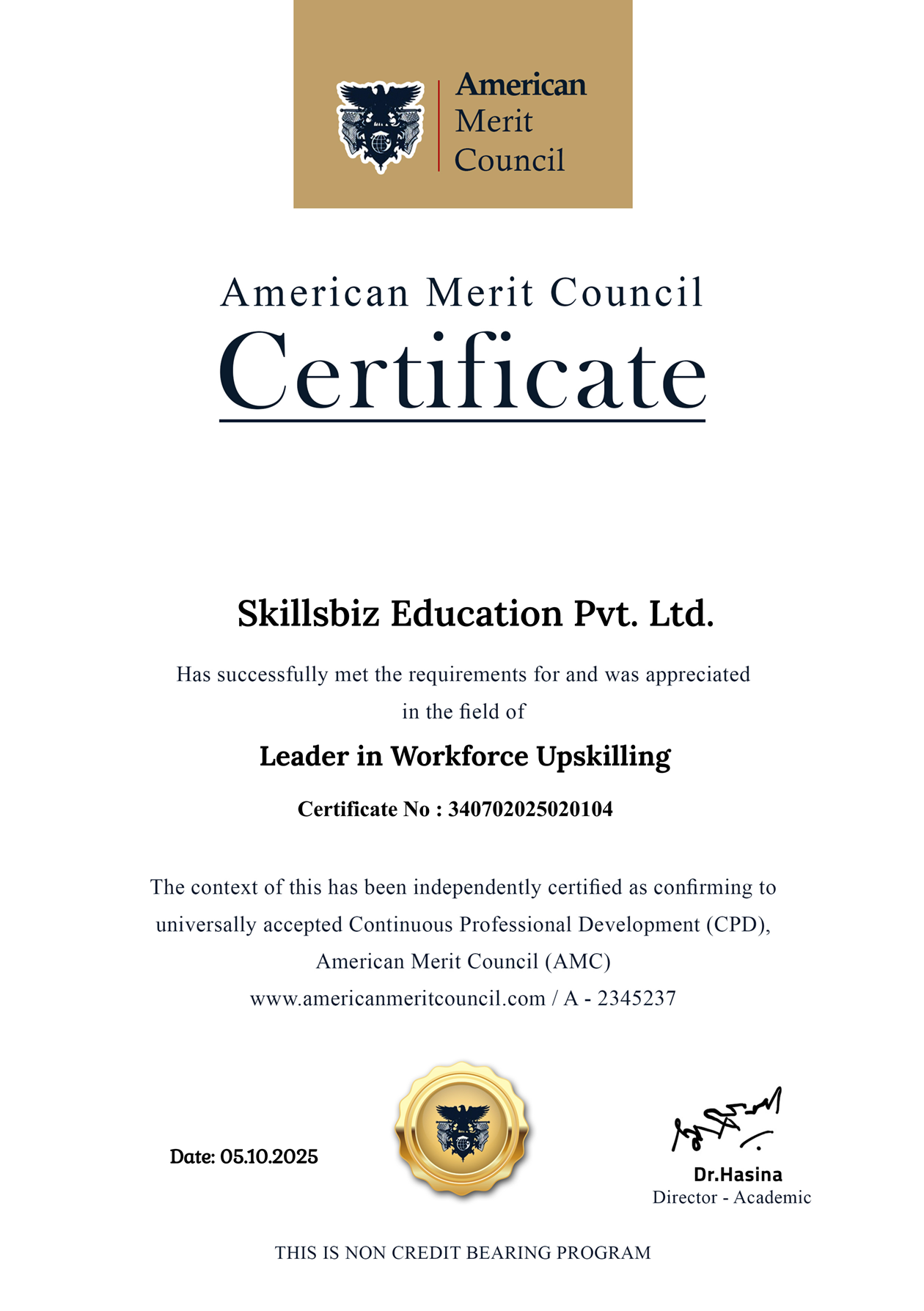
Honored for excellence
Awards & recognitions
Our pedagogy, learner outcomes, and mentor network have been acknowledged by industry councils and global forums.




Media spotlight
Featured in leading publications










Ready to start Lean Six Sigma Black Belt Certification...?
Enroll today or book a free counselling call to get a personalized learning path.