React Frontend Developer Course
Become a proficient React developer in just 32 hours through hands-on projects and real-world examples!
Program rating
1,107+
Learners enrolled
32 hrs
Total duration
English,Hindi
Language
This program includes

Program overview
About this program
This Technology & IT program blends live, mentor-led sessions with hands-on projects and real-world case studies, so you build genuinely job-ready skills — not just theory. You'll learn from working industry experts, apply what you learn on practical assignments, and finish with a portfolio, a recognized certificate, and dedicated placement support to help you land the right role.
Become a proficient React developer in just 32 hours through hands-on projects and real-world examples!
This course covers all the essential aspects of React development, including components, state management, and hooks. You'll learn how to build responsive and interactive user interfaces and become job-ready with real-world scenarios.
Why learners love this program
- Hands-on projects: Build real-world React applications to practice concepts and create a portfolio.
- Core React skills: Master components, state management, hooks, routing, and modern best practices.
- Career preparation: Resume tips, interview practice, and real-world scenarios to get job-ready.
16
Lectures
32
Hours
All level
Level
Globally trusted accreditations
Recognitions that power your profile
Trusted by leading accreditation bodies — so your certificate is respected by employers worldwide.








Learning outcomes
What you'll be able to do
Curriculum
Structured modules that build real skills
15 modules · designed for progressive, hands-on learning.
What is React?
Understand React's core purpose and how it differs from traditional web approaches.
Benefits and Use Cases
Identify common use cases and advantages of using React in modern web development.
Tooling and Editors
Set up a productive development environment with recommended editors and essential tools.
Creating a New Project (CRA / Vite)
Create and run a new React project using popular starters and understand project structure.
Functional vs Class Components
Differentiate functional and class components and when to choose each approach.
Component Composition and Reusability
Apply composition patterns to build reusable and maintainable components.
Stateful Component Patterns
Recognize patterns for organizing state within components and managing complexity.
JSX Syntax and Expressions
Use JSX to describe UI and embed JavaScript expressions safely within markup.
Rendering Lists and Conditional Content
Render dynamic lists and conditionally display elements using React idioms.
Local Component State (useState)
Manage local state in functional components using useState and update patterns.
State Patterns and Lifting State Up
Share state between components by lifting it up and choosing appropriate state owners.
Passing Data with Props
Pass data and callbacks between components and understand unidirectional data flow.
Prop Validation and Default Values
Use prop validation and defaults to make components predictable and robust.
Handling Events in React
Implement event handlers and manage event propagation within React components.
Forms and Controlled Components
Build controlled form components and handle user input reliably.
Class Component Lifecycle Methods
Understand lifecycle methods in class components and appropriate use cases for each.
Lifecycle Patterns in Functional Components
Translate lifecycle needs to functional components using hooks and effect patterns.
useState and useEffect Basics
Manage state and side effects in functional components using useState and useEffect.
Using useRef and useMemo
Use useRef for mutable values and useMemo for optimizing expensive computations.
Custom Hooks
Encapsulate reusable logic into custom hooks to improve code reuse and testability.
Performance and Effect Optimization
Optimize hook usage to avoid unnecessary renders and manage effect dependencies.
Basic Routing and Link Navigation
Implement client-side routing and navigation using React Router components.
Route Parameters and Nested Routes
Handle dynamic routes, nested routes, and route-based UI composition.
CSS Modules and Global Styles
Apply scoped styles with CSS modules and manage global stylesheet concerns.
Styled-components and CSS-in-JS
Use CSS-in-JS solutions to style components with dynamic props and theming.
Redux Fundamentals: Store, Actions, Reducers
Explain core Redux concepts and structure application state with reducers and actions.
Connecting React and Redux (react-redux)
Connect components to the Redux store and dispatch actions using react-redux APIs.
Async Flows and Middleware (thunks/sagas)
Handle asynchronous actions and side effects using middleware patterns like thunks.
Unit Testing Components (Jest & React Testing Library)
Write unit tests for components and hooks using Jest and React Testing Library.
Integration and End-to-End Testing Concepts
Understand integration testing and e2e testing strategies for full app flows.
Optimizing and Building for Production
Prepare applications for production with bundling, code splitting, and performance tweaks.
Deployment Options and CI/CD Basics
Deploy React apps to common platforms and introduce continuous deployment practices.
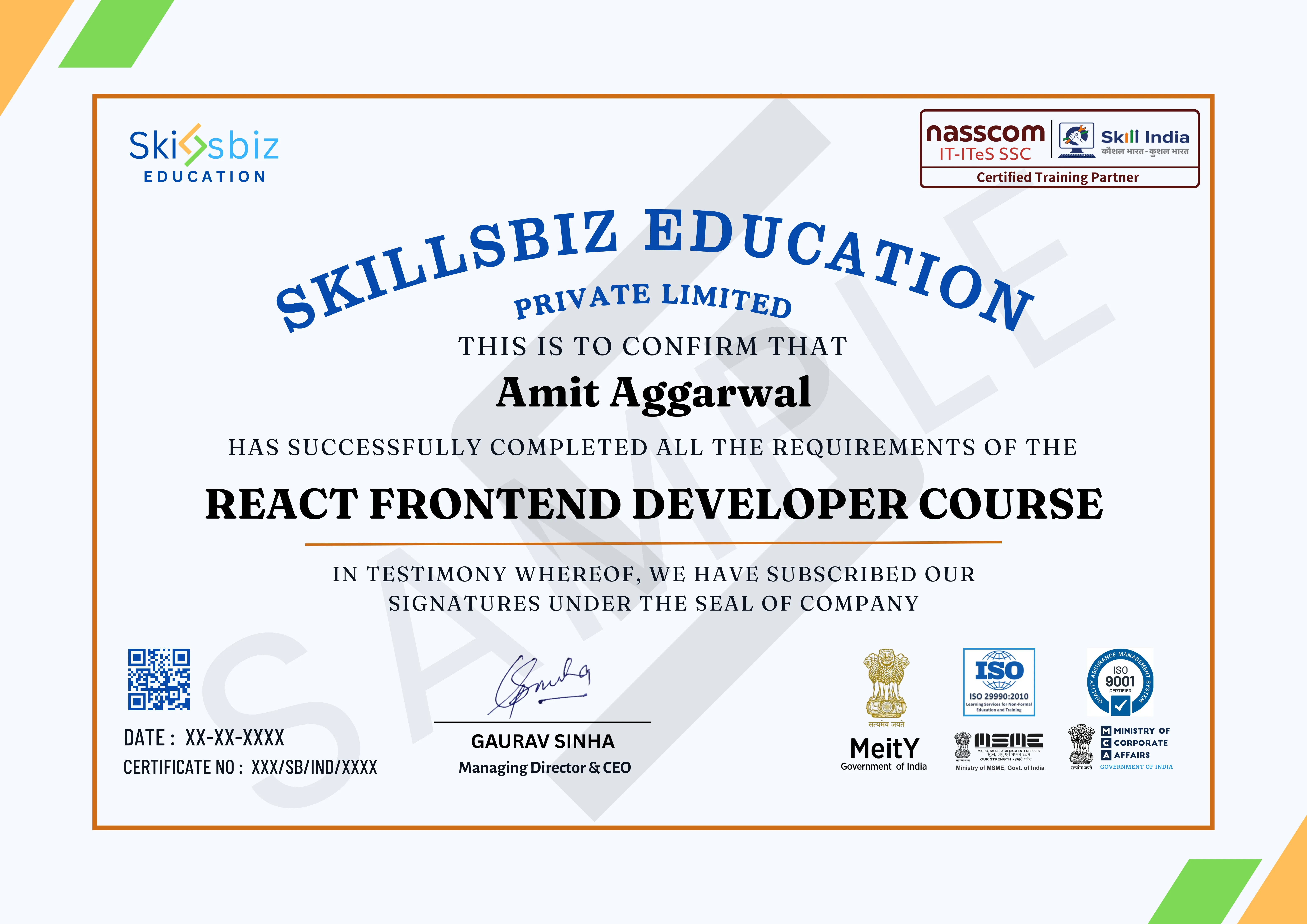
Your credential
The certificate you'll earn
Earn an industry-recognized certificate on successful completion of this program.
Personalised guidance
Book a free discovery call with our specialists
Get tailored advice on learning paths, certification journeys, and industry opportunities before you enroll.
- Understand the skill gaps holding you back and the modules that close them.
- Get a cohort recommendation based on availability and your weekly bandwidth.
- Discover certification add-ons that strengthen your CV.
Reserve your slot
Share your details and we'll connect within 24 hours.
Reviews
What our learners say
Practising React with real UI challenges helped me grow fast. Understanding component communication and routing made building pages easier.
I enjoyed how clear and structured the teaching style was. Once I understood hooks and lifecycle concepts, building React apps became genuinely fun.
React felt challenging at first, but the trainer explained each concept in a simple, relatable way. Building UI components helped me understand how modern websites are created.
I appreciated how interactive the sessions were. Building small features and then combining them into a full app helped me understand React’s structure properly. My coding confidence increased a lot.
This course helped me shift from basic JavaScript to full-fledged React development. Concepts like props, context API, and reusable components made much more sense through clear examples.
I really liked how the course focused on real projects from day one. Understanding React state management and routing helped me build complete, functional apps without confusion.
FAQ
Your questions, answered
Everything you need to know before you enroll. Still unsure? Our advisors are one call away.
Honored for excellence
Awards & recognitions
Our pedagogy, learner outcomes, and mentor network have been acknowledged by industry councils and global forums.





Media spotlight
Featured in leading publications









Ready to start React Frontend Developer Course?
Enroll today or book a free counselling call to get a personalized learning path.