Professional MySQL Certification Program
Enhance your database management skills with our Professional My SQL Certification Program. This comprehensive course covers everything from basics to advanced MySQL concepts.
Program rating
1,763+
Learners enrolled
50 hrs
Total duration
English,Hindi
Language
This program includes

Program overview
About this program
This Data Analyst program blends live, mentor-led sessions with hands-on projects and real-world case studies, so you build genuinely job-ready skills — not just theory. You'll learn from working industry experts, apply what you learn on practical assignments, and finish with a portfolio, a recognized certificate, and dedicated placement support to help you land the right role.
Enhance your database management skills with our Professional My SQL Certification Program. This comprehensive course covers everything from basics to advanced MySQL concepts.
This Professional My SQL Certification Program is designed for individuals looking to deepen their understanding of MySQL database management. Over the course of 50 hours, you will learn about database design, SQL queries, data manipulation, and optimization techniques. Through practical exercises and real-world scenarios, you will gain the skills necessary to become a proficient MySQL developer.
Why learners love this program
- Comprehensive curriculum from fundamentals to advanced MySQL topics (database design, SQL querying, transactions, stored procedures, and data modeling).
- Performance and optimization techniques including indexing, query tuning, caching, and scalability best practices.
- Hands-on labs and real-world projects with exam-focused certification preparation across a 50-hour practical training program.
25
Lectures
50
Hours
All level
Level
Globally trusted accreditations
Recognitions that power your profile
Trusted by leading accreditation bodies — so your certificate is respected by employers worldwide.










Learning outcomes
What you'll be able to do
Curriculum
Structured modules that build real skills
11 modules · designed for progressive, hands-on learning.
Overview and history of MySQL
Understand the origins, core features, and typical use cases for MySQL. Develop awareness of where MySQL fits in modern application stacks.
MySQL ecosystem and editions
Learn about the MySQL ecosystem, tools, and different editions (community vs enterprise). Identify common integrations and deployment scenarios.
Installation on Windows
Follow a step-by-step Windows installation and perform initial verification of the server. Configure basic settings to prepare for development use.
Installation on Linux/macOS and initial configuration
Install MySQL on Linux/macOS and configure service management and basic security settings. Validate connectivity and set up a default user and database.
Data modeling and ER diagrams
Create entity-relationship diagrams and translate business requirements into a logical data model. Define entities, relationships, and cardinalities for a schema.
Normalization principles
Apply normalization rules to reduce redundancy and ensure data integrity. Recognize normal forms and when to normalize a schema.
Denormalization and practical design trade-offs
Understand when denormalization is appropriate for performance or simplicity and how to apply it safely. Balance normalization and denormalization for real-world scenarios.
SELECT statements and filtering
Write basic SELECT queries with WHERE clauses to retrieve and filter data. Use predicates to refine result sets and practice common query patterns.
Aggregations and GROUP BY
Use aggregate functions and GROUP BY to summarize data and compute metrics. Apply HAVING to filter aggregated results.
Sorting, limiting, and basic joins
Order and limit query results, and perform basic JOINs to combine related tables. Explain inner vs outer joins and when to use each.
Complex joins and set operations
Construct complex multi-table joins and use set operations (UNION, INTERSECT) where applicable. Optimize join order and understand execution considerations.
Subqueries and correlated queries
Write subqueries and correlated subqueries for advanced filtering and conditional logic. Choose between joins and subqueries based on clarity and performance.
INSERT operations and bulk loading
Perform single and bulk INSERT operations, including LOAD DATA techniques and import strategies. Understand methods to validate and clean data during ingestion.
UPDATE and DELETE with safety patterns
Execute UPDATE and DELETE statements safely using transactions and WHERE clauses, and apply techniques to prevent accidental data loss. Use backups and transaction rollbacks for recovery.
Transactions, isolation levels, and locking
Explain ACID properties, transaction isolation levels, and locking behavior in MySQL. Manage concurrency and resolve common contention issues.
Index types and design
Understand different index types (B-tree, hash, full-text) and how to design effective indexes for queries. Evaluate index trade-offs for read/write workloads.
Query optimization and EXPLAIN
Use EXPLAIN to analyze query execution plans and identify bottlenecks. Apply optimization techniques such as rewriting queries and adding appropriate indexes.
Creating stored procedures
Write stored procedures for encapsulating business logic and reusable operations inside the database. Handle parameters, control flow, and error handling.
User-defined functions and triggers
Create user-defined functions and triggers to extend database capabilities and automate tasks. Understand use cases and limitations for each mechanism.
Authentication, users, and privileges
Manage MySQL users, roles, and privileges to enforce least privilege access. Implement secure authentication practices and audit user permissions.
Encryption, network security, and best practices
Apply encryption at rest and in transit, secure network configurations, and follow hardening best practices to protect data. Establish procedures for ongoing security maintenance.
Backup methods and scheduling
Learn logical and physical backup methods (mysqldump, XtraBackup) and design backup schedules to meet RPO/RTO requirements. Automate and verify backups.
Point-in-time recovery and restore procedures
Perform point-in-time recovery using binary logs and practice restore procedures in controlled environments. Validate recovery steps and document runbooks.
Disaster recovery planning and testing
Develop a disaster recovery plan including failover strategies and recovery testing. Conduct drills to ensure readiness and refine the recovery process.
Project planning and dataset setup
Plan a capstone project, prepare datasets, and design the schema based on real-world requirements. Set success criteria and development milestones.
Implementation, optimization, and presentation
Implement the solution, apply performance tuning and security measures, and present findings and lessons learned. Demonstrate working knowledge across the course topics.
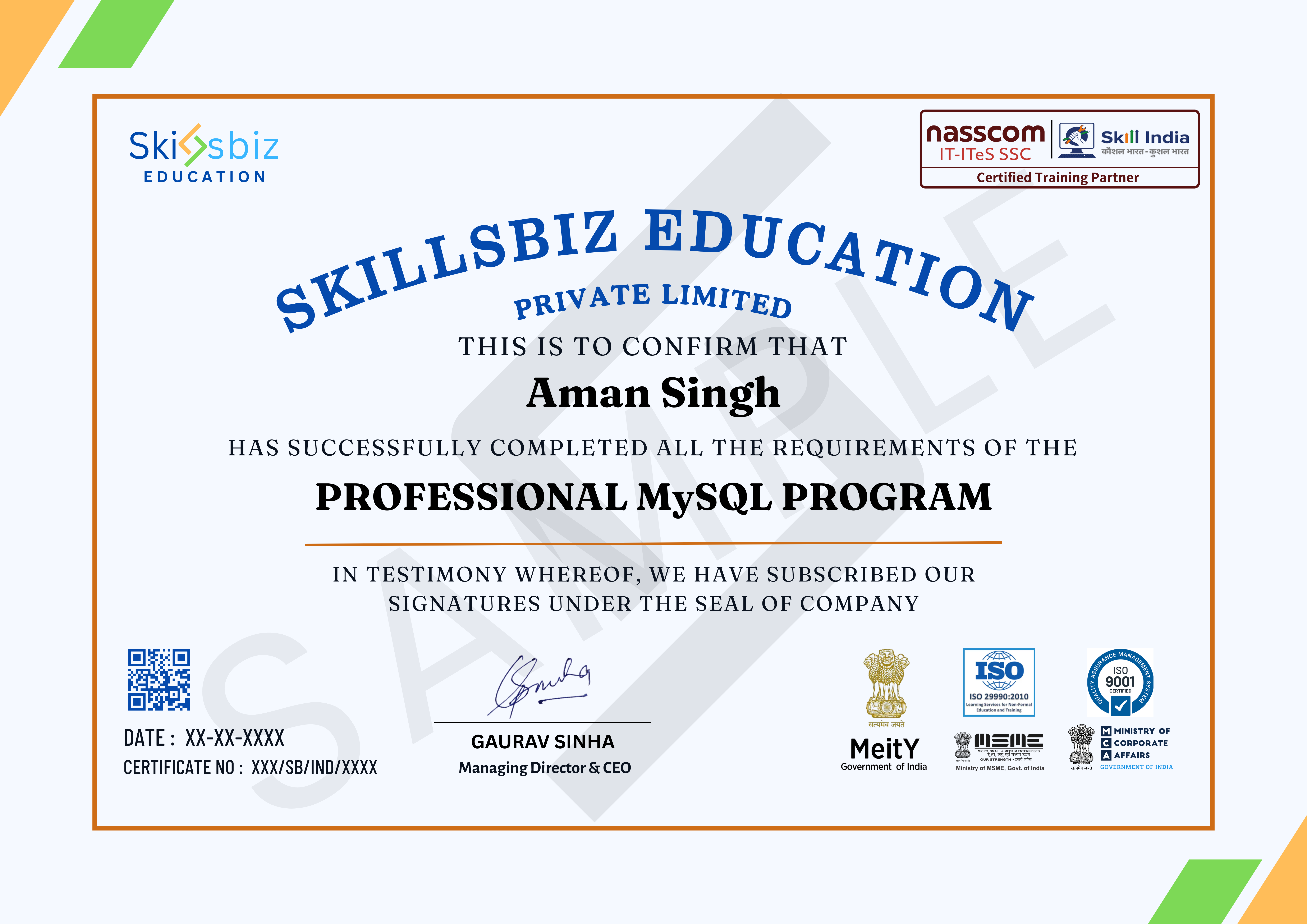
Your credential
The certificate you'll earn
Earn an industry-recognized certificate on successful completion of this program.
Personalised guidance
Book a free discovery call with our specialists
Get tailored advice on learning paths, certification journeys, and industry opportunities before you enroll.
- Understand the skill gaps holding you back and the modules that close them.
- Get a cohort recommendation based on availability and your weekly bandwidth.
- Discover certification add-ons that strengthen your CV.
Reserve your slot
Share your details and we'll connect within 24 hours.
Reviews
What our learners say
The MySQL program was both detailed and practical. The trainer explained every concept patiently and provided enough exercises for practice. I now feel ready to apply my knowledge in real projects.
The course was structured in a way that even beginners could follow. The trainer explained concepts like normalization and foreign keys very clearly. The practice tasks gave me a lot of confidence.
This course helped me gain clarity in database management. The trainer explained queries and functions step by step, which made learning easy. I feel confident to work with databases now.
The course gave me a practical understanding of databases. I liked the way the trainer explained joins, subqueries, and functions with real-time examples. It was a very useful learning experience.
This training was excellent for learning database management. The trainer explained normalization, indexing, and stored procedures very clearly. I now feel confident in writing and optimizing SQL queries.
The MySQL course was very well structured and easy to follow. The trainer explained database concepts, queries, and joins in detail. The hands-on practice sessions helped me build a strong foundation in SQL.
FAQ
Your questions, answered
Everything you need to know before you enroll. Still unsure? Our advisors are one call away.
Honored for excellence
Awards & recognitions
Our pedagogy, learner outcomes, and mentor network have been acknowledged by industry councils and global forums.





Media spotlight
Featured in leading publications










Ready to start Professional MySQL Certification Program?
Enroll today or book a free counselling call to get a personalized learning path.